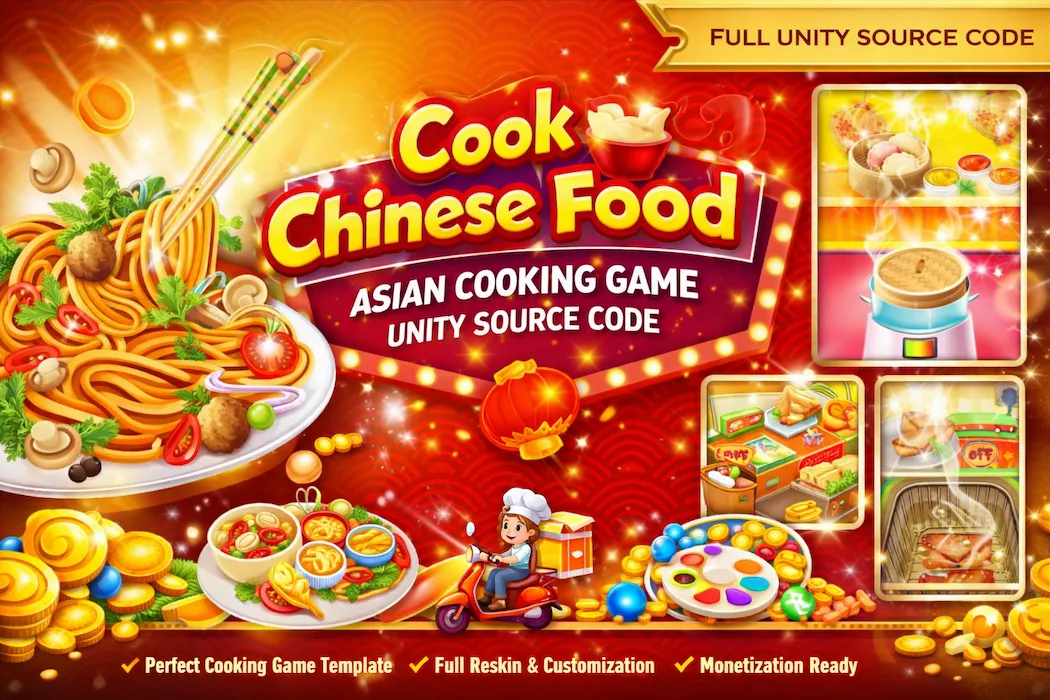

The order ticket prints. Three tables want noodles, one wants dumplings, and the fryer just finished a batch that needs plating before it goes cold. That controlled chaos — the exact feeling of a real kitchen during dinner rush — is what Cook Chinese Food: Asian Cooking Games is built to simulate, minus the burns and the yelling.
Time-management cooking games have been a mobile staple for over a decade, and for good reason: they combine fast decision-making, visual satisfaction, and a genre that translates across every culture and cuisine imaginable. This template takes that proven formula and wraps it around the flavors, dishes, and visual identity of Chinese cooking.
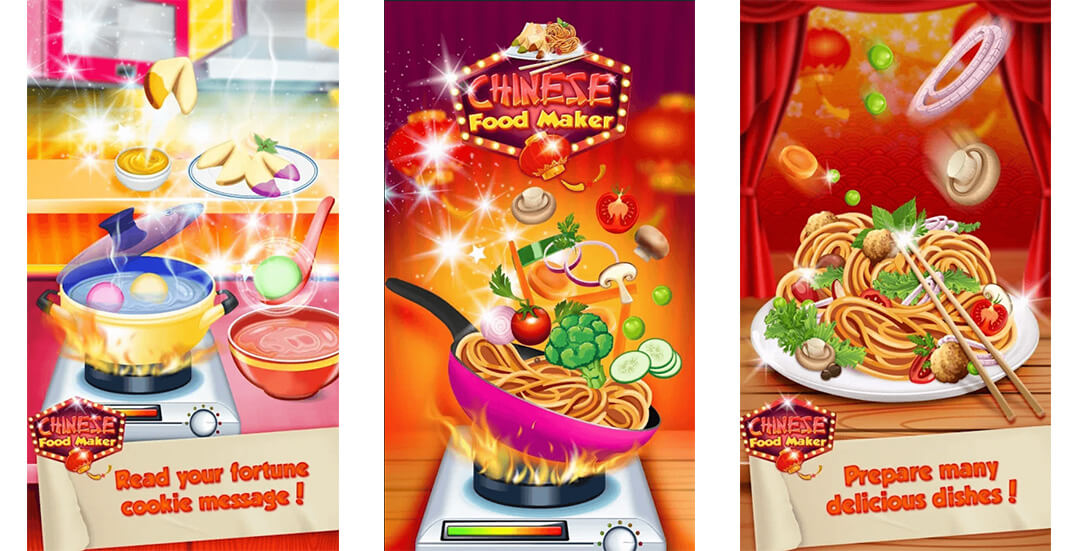
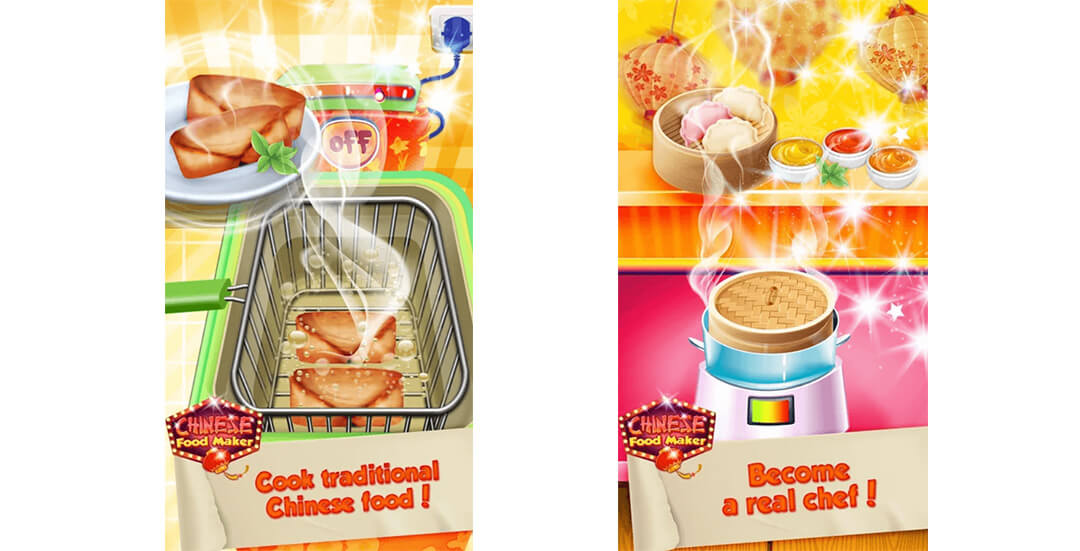
Rather than generic burgers or pizza, players work through a menu built around Chinese cuisine — noodles, fried rice, dumplings, and dishes that unlock as progression continues. The recipes follow distinct step-by-step preparation sequences, so cooking a dish isn't just a single tap, it's a small sequence of actions that mirrors how the dish would actually come together.
That structure does double duty. It makes each recipe feel a little more authentic than a generic "tap the food" interaction, while still keeping the actual controls simple enough for a five-second learning curve.
Every cooking game lives or dies on how well it manages pressure, and this one leans fully into that tension:
None of these mechanics are new to the genre, but the execution here is tight enough that the pressure feels fair rather than punishing — difficulty ramps gradually rather than throwing an overwhelming rush at players before they've learned the basics.
Static content kills replay value fast in this genre, so the template is built around a menu that expands as players progress. New dishes unlock with their own preparation sequences, gradually introducing more complex recipes that demand better time management and multitasking. It's a simple but effective retention lever — players keep playing partly to unlock the next dish, not just to beat the clock.
Cooking games fail fast when controls get in the way of quick decision-making, so this template keeps interaction minimal:
That accessibility is what makes the genre so broadly appealing — you don't need reflexes or strategy expertise, just quick thumbs and a willingness to keep pace.
Visual polish matters more in cooking games than almost any other casual genre — if the food doesn't look good, the whole fantasy falls apart. The template leans into a bright, colorful kitchen environment with clean animations and appealing food presentation, which does a lot of quiet work in making each successful order feel satisfying rather than purely mechanical.
The engagement design here follows familiar but effective patterns: difficulty increases gradually, a reward-based progression system keeps players chasing the next unlock, and time-based challenges create natural tension without ever feeling unfair. Add in the replay incentive of trying to beat a previous performance score, and you get a loop that holds attention well past a single play session.
From a developer's perspective, the appeal isn't just the finished game — it's how easily this template can be reshaped:
Cooking games are also one of the more forgiving genres for reskinning, since swapping cuisines or restaurant themes rarely requires touching the underlying mechanics — only the assets around them.
Post-launch, there's a clear roadmap for expanding the experience: new cuisines and recipe lines, kitchen upgrade systems, daily login rewards, sharper UI and sound design, and deeper monetization layers. None of these require rebuilding the core loop — they're additive systems that extend session length and long-term retention.
Time-management cooking games aren't for everyone, and it's worth knowing what else is available if you're weighing options before committing to a build. For a completely different kind of mental challenge, Puzzle King leans into logic-driven gameplay rather than time pressure, while Rise of Ooze shows how a puzzle mechanic can carry an entirely different visual identity and pacing.
On the opposite end of the intensity spectrum, Rampant Racing trades kitchen multitasking for raw speed and reflex-driven competition, while action-focused titles like Real Sniper: Legacy Shooter 3D and Rip 'Em a New One demonstrate just how differently a mission-based structure can drive engagement compared to a time-management loop. Seeing this range side by side is useful context — cooking games win on broad, casual appeal, while action and puzzle genres tend to win on depth or intensity, depending on what you're optimizing for.
If you're relatively new to working with Unity source code and trying to figure out which genre to build first, it's worth reading through the top 10 Unity game source codes for beginners in 2026 — cooking and time-management titles are consistently recommended as beginner-friendly starting points because the mechanics are easy to reason about even if the difficulty curve for players is well tuned.
For a wider look at what's currently performing well across the catalog, the bestseller collection is a solid reference point for gauging which genres and themes are resonating with other developers right now. And if you're just getting oriented with the marketplace as a whole, the homepage is the easiest place to see the full breadth of what's available before narrowing down your next project.
Cook Chinese Food: Asian Cooking Games captures everything that makes the time-management cooking genre so durable — quick decisions, visual reward, gradually escalating pressure, and a theme with broad cultural appeal. For developers, it also offers something just as valuable: a flexible, ready-to-launch foundation that can be reshaped into an entirely different cuisine or restaurant concept without touching the mechanics underneath.
Do I need cooking-game design experience to work with this template? No. The gameplay systems — order-taking, cooking sequences, and serving mechanics — are already implemented, so you're customizing content and visuals rather than designing the genre's mechanics from scratch.
Can I change the cuisine theme to something other than Chinese food? Yes. Because dish assets and recipe sequences are built modularly, the theme can be adapted toward other cuisines or restaurant concepts without reworking the core time-management loop.
What Unity version does this project require? The current build uses Unity 2018.3f1, and requires the free Unity license version 2019 or later along with macOS and Xcode for iOS builds.
Is this genre still popular with mobile audiences? Time-management cooking games have remained a consistently strong casual category for years, largely due to their broad accessibility and satisfying, fast-paced gameplay loop.
How is monetization typically handled in games like this? Common approaches include rewarded ads for bonus time or ingredients, interstitial ads between levels, and progression-based in-app purchases like kitchen upgrades.
Can new dishes and levels be added after the initial release? Yes, the structure is designed to support ongoing content additions, including new recipes, difficulty tiers, and kitchen upgrade systems.
Is this a good template for a developer's first mobile game? It's a reasonable choice for newer developers, since the mechanics are straightforward to understand and the codebase is structured for manageable customization.
Does the purchase include documentation and support? Yes, documentation is provided, and support options are available depending on the license tier selected at checkout.
You need to login to comment!
Total Sold:
0
Total Comments: