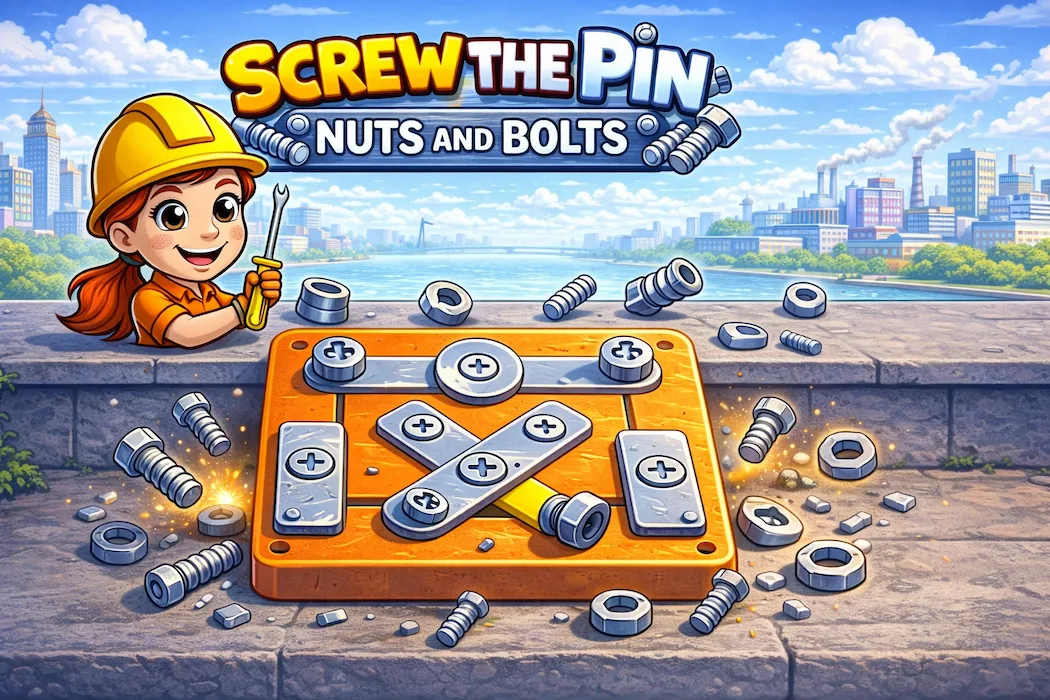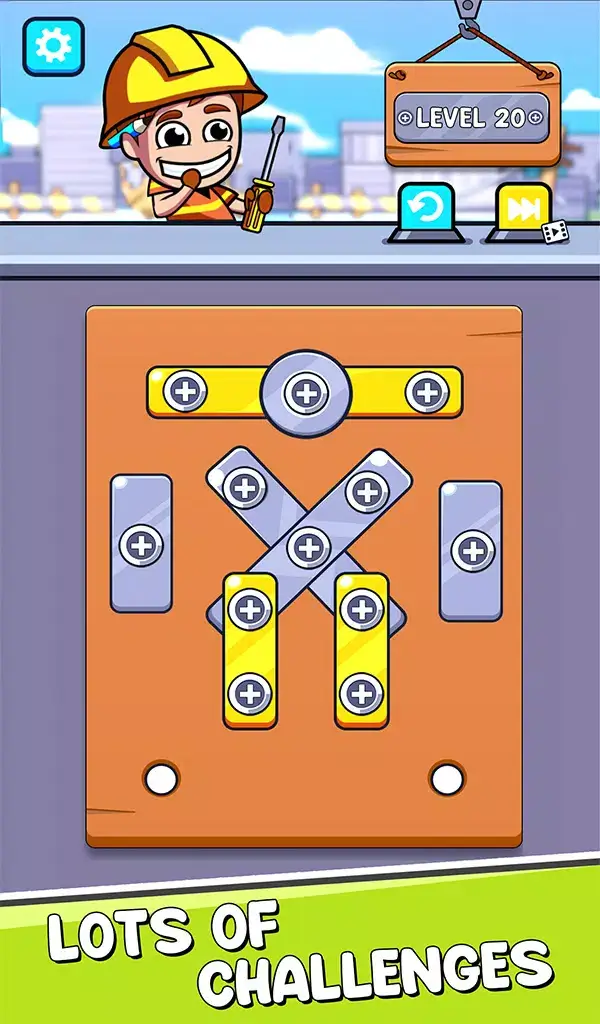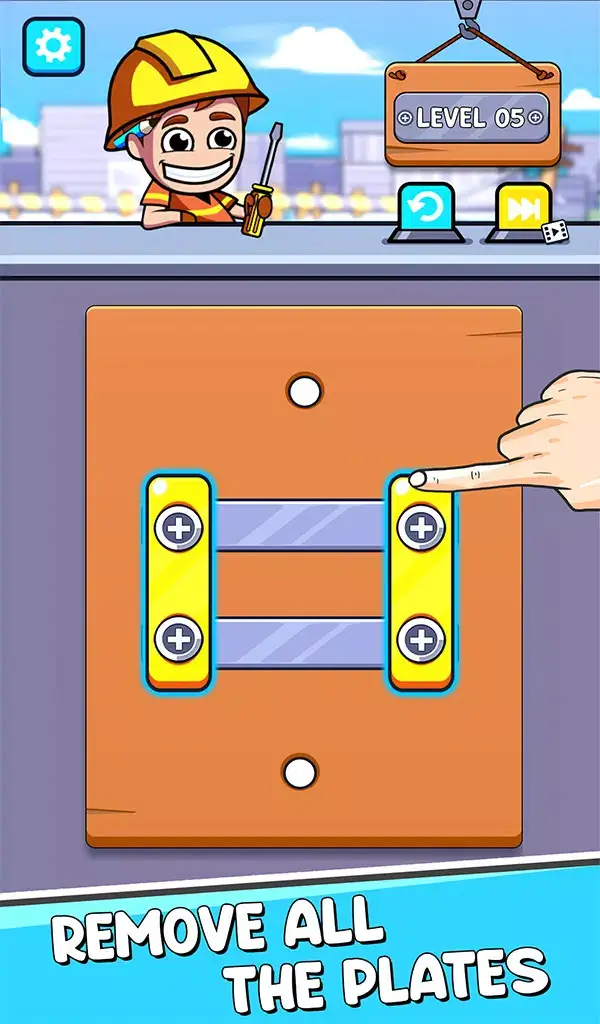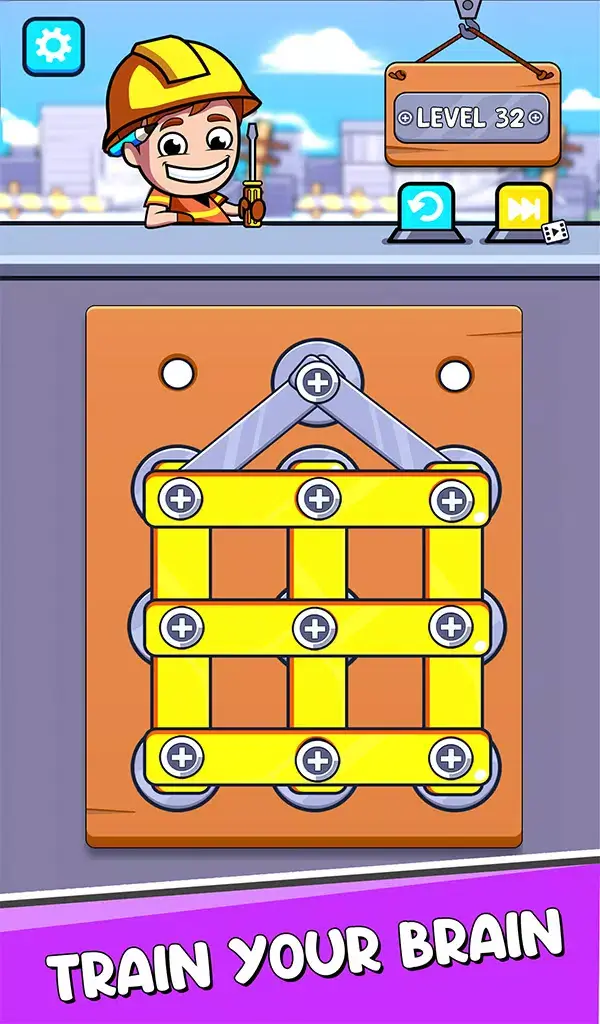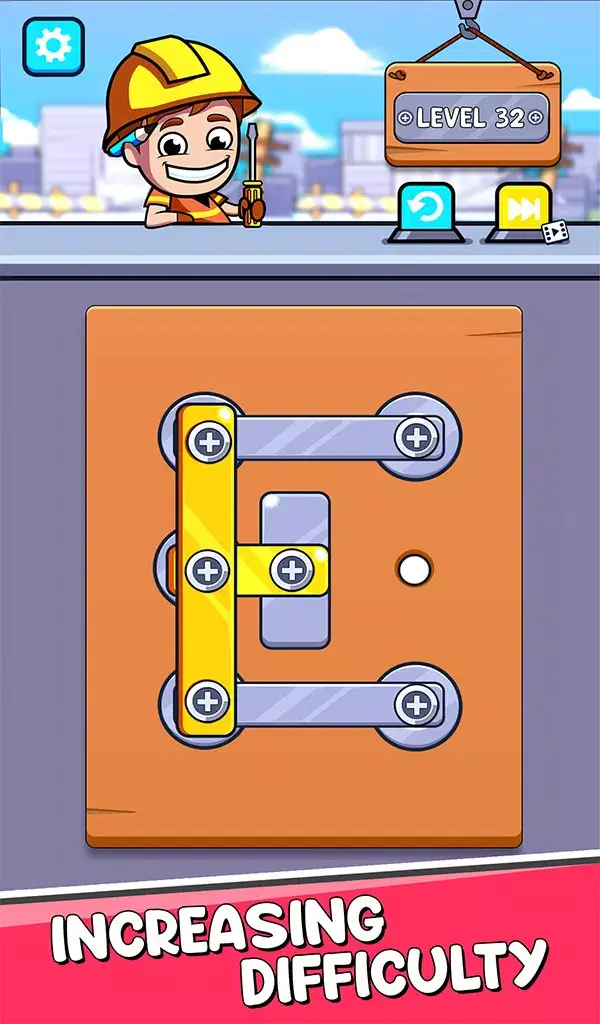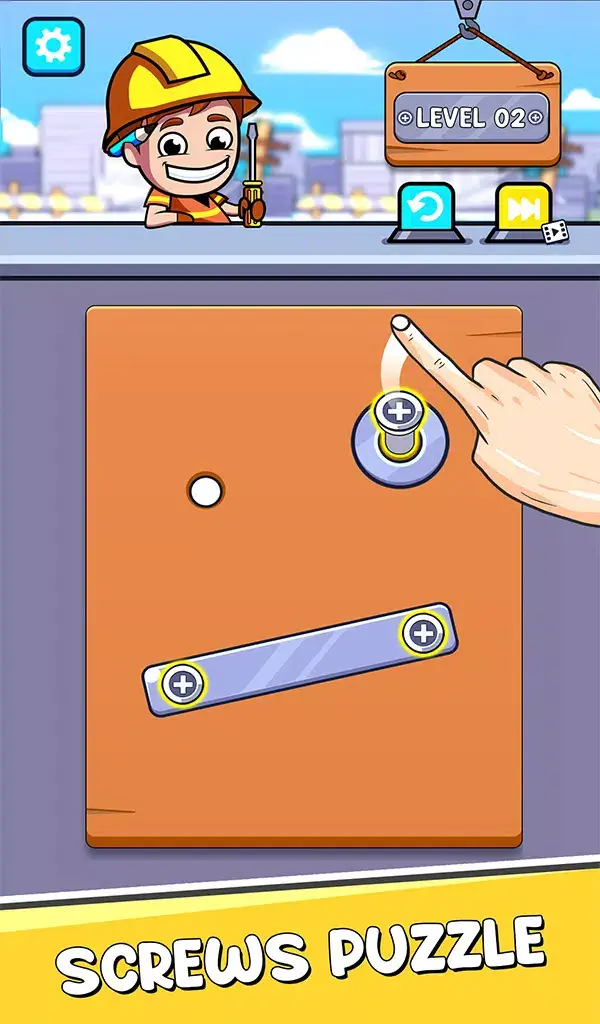
Puzzle games that challenge logic while remaining simple to play are dominating the mobile gaming market—and Screw The Pin: Nuts & Bolts Brain Teaser fits perfectly into this high-performing category. Built using Unity, this game introduces a mechanical puzzle concept where players must strategically unscrew pins, release objects, and solve cleverly designed challenges.
What makes this concept powerful is its ability to combine visual satisfaction with logical thinking, creating a gameplay loop that feels both relaxing and mentally stimulating. Whether you’re a developer looking for a ready-to-launch Unity project or someone aiming to build a puzzle game portfolio, this template offers strong potential.
At first glance, the game looks easy—just remove screws and let objects fall into place. But as players progress, they quickly realize that every move matters. The order in which pins are removed can determine success or failure.
Each level introduces:
This layered gameplay ensures that players stay engaged over long sessions. Unlike repetitive puzzle formats, this game evolves continuously, offering fresh challenges at every stage.
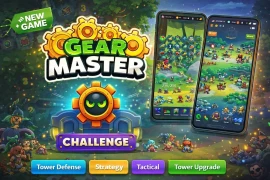
👉 If you’re exploring similar puzzle mechanics with a different visual style, you can also integrate variety by linking related content like:
[👉 Mr Potato Puzzle Master]
Brain teaser games have a massive audience because they:
“Screw The Pin” leverages all of these strengths. The mechanical theme (nuts, bolts, screws) adds a unique twist that differentiates it from common match-3 or tap-based puzzle games.
This uniqueness helps your page rank better because you're not just targeting “puzzle game Unity”, but also niche keywords like:
From a development perspective, this Unity game source code is designed to be flexible and scalable. Whether you want to launch quickly or build a more advanced version, the structure supports both.
You can easily:
For developers managing multiple game listings (like your site), this is a huge advantage. You can reuse the core system while making each game feel completely different.
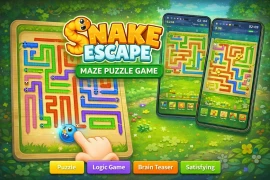
👉 For example, you could connect this with another logic-based puzzle experience here:
[👉 Blast Puzzle Unity Template]
This type of puzzle game naturally supports multiple monetization strategies because players often get stuck and look for help.
Best-performing options include:
Because the frustration level is controlled (challenging but fair), users are more willing to watch ads instead of quitting. This directly improves eCPM and retention rate.
Since you mentioned you have 500+ games, this is where this template becomes extremely valuable.
You can:
👉 Explore more variations here:
[👉 Popular Games Collection]
This game is designed specifically for mobile users, which is critical for success in today’s app market.
Key features include:
These elements ensure that the game runs efficiently across devices, improving user satisfaction and retention.
To maximize performance, you can enhance the base game with:
These features increase repeat visits, which is a major ranking factor indirectly (through engagement signals).
Development Guide
🗓 June 10, 2026⏱ 8 min read🏷 Unity · Physics Puzzle · Mobile Game Dev
Physics puzzle games are among the most downloaded and highest-retained categories in mobile gaming. The nuts and bolts (screw-the-pin) mechanic in particular has exploded in popularity because it requires zero tutorial — players intuitively know what screws do — yet the puzzle depth is virtually limitless.
In this guide, we walk through the core architecture of a screw-pin puzzle game built in Unity 2D, covering everything from physics setup to level design.
Create a new Unity 2D project. The first thing to configure is your Physics 2D layer matrix. You'll need at least three distinct layers:
Disable collision between Pins and Ground layers — pins should only interact with objects they're holding. This prevents unintended physics jitter when pins are removed.
Each pin is a GameObject with a Rigidbody2D set to Kinematic while attached, and a HingeJoint2D connecting it to the object it restrains. When the player taps a pin:
The order of pin removal is everything. A level where all pins are equal is a tap-fest. The design skill is creating interdependencies — pin A holds the only thing stopping object B from blocking target C.
The puzzle depth in screw games comes from chained dependencies between objects. An object can be both held by pins and blocking another object simultaneously. When designing levels, think in terms of dependency graphs rather than individual puzzle pieces.
Store level state in a serializable LevelData ScriptableObject. This makes your level editor scene-agnostic — each level is just a data asset, and the game scene loads whichever LevelData is currently active.
Difficulty in screw puzzle games should be a function of the number of interdependencies, not the number of pins. A level with three pins and one chain of dependencies plays easier than a level with two pins where one object blocks three others.
The difference between a game that gets 2-star reviews and 5-star reviews is often purely in the feel. Three things that make a screw puzzle game feel great:
Want to skip the build phase entirely? The Screw The Pin Unity source code from Unity Source Code includes the full physics-based puzzle engine described above, pre-built level system, and polished animations — ready to customize and publish.
→ Get the complete Unity source code
Monetization
🗓 May 22, 2026⏱ 10 min read🏷 AdMob · Unity · Puzzle Game Revenue
Publishing a mobile game is the easy part. Making consistent revenue from it requires a deliberate monetization architecture. Casual puzzle games — especially physics-based ones like nuts & bolts games — sit in a monetization sweet spot that many developers underutilize.
Here's a complete playbook for maximizing revenue from a Unity puzzle game using AdMob in 2026.
Puzzle games have two properties that make them ideal for ad monetization. First, they create natural pause moments — the player finishes a level, takes a breath, and isn't actively doing anything for 2–3 seconds. Interstitial ads inserted here feel far less intrusive than in action games. Second, difficulty walls create demand for optional rewards. Players who are stuck on a level are highly motivated to watch a 30-second ad for an extra hint or a free undo.
Rewarded ads should be your primary monetization focus. In puzzle games, the conversion rate for "Watch ad to continue" or "Watch ad for a hint" is consistently higher than in other genres because the player already has intent — they want to solve the level.
Optimal trigger points for rewarded ads in a screw puzzle game:
Never show an interstitial immediately after a failed level — it creates frustration at the worst moment. Show interstitials only on level completion, and space them at every 2–3 completions rather than every level. This improves both user retention and long-term ad revenue by keeping players in the game longer.
Banner ads generate low eCPM but require zero user interaction. Place a small banner at the bottom of level-selection screens and menus only — never during active gameplay, where they distract and reduce session length.
Google's App Open ad format shows an ad when the user returns to your game from the background. In 2025–2026, this format has shown strong eCPM in casual game categories. It's worth testing once your daily active user count exceeds a few hundred.
eCPM varies significantly by region and time of year. As rough reference points for planning: rewarded videos in Tier 1 markets (US, UK, AU, CA) average $10–25 eCPM; interstitials average $3–8; banners average $0.30–0.80. These numbers can triple during Q4 holiday ad spend peaks.
All ad revenue formulas reduce to: DAU × sessions per user × ads per session × eCPM. The only lever developers control long-term is DAU and sessions per user — which means retention. Every decision about difficulty, progression, and rewards should be evaluated through the lens of Day 1 / Day 7 / Day 30 retention first, and monetization second. A game with 40% Day-1 retention and moderate ad density will out-earn a game with 15% Day-1 retention and aggressive ads every time.
AdMob already integrated: The Screw The Pin Unity source code includes pre-wired AdMob placements for rewarded video, interstitials, and banners. Replace your ad unit IDs and you're earning from day one.
→ Download the monetized Unity source code
ASO & SEO
🗓 April 15, 2026⏱ 7 min read🏷 ASO · App Store · Google Play · Puzzle Games
Over 65% of app downloads still come from organic store search. For indie developers publishing puzzle games, App Store Optimization (ASO) is the highest-ROI marketing channel available — and most developers execute it poorly. This guide covers what actually moves the needle in 2026.
Your keyword strategy should target three tiers simultaneously:
The app title carries the highest keyword weight in both Google Play and the App Store algorithm. Your primary mechanic keyword must be in the title. For a nuts and bolts puzzle game, a well-optimized title follows the pattern: [Brand/Hook] – [Mechanic keyword] [Category keyword].
Example: "Screw The Pin – Nuts & Bolts Puzzle Game". This title contains three independently searched terms: "screw the pin", "nuts and bolts puzzle", and "puzzle game".
The first three lines of your description appear before the "more" fold on most devices — treat them as your ad headline. Lead with the core player benefit (what's fun and why), not with a feature list. Feature lists belong in bullet points after the fold.
On Google Play, the full description is indexed as a web page. Include your target keywords naturally at a density of roughly 2–3% — keyword stuffing triggers ranking penalties. On the App Store, only the title, subtitle, and keyword field are indexed; the long description is for human readers only.
Screenshots are your conversion rate lever — they determine whether someone who found your game actually downloads it. Data from A/B tests across casual game categories consistently shows:
The algorithm treats rating volume and average equally. A game with 200 reviews at 4.5 stars will outrank a game with 20 reviews at 5.0 stars. Timing your review prompt is critical: ask after a level completion (positive emotional state), never after a failure or ad. A prompt saying "Enjoying the game? It takes 10 seconds to rate it" at the right moment converts at 3–5× the rate of default OS review prompts.
Localizing your store listing metadata (title, description, screenshots) — not necessarily the game itself — can multiply organic installs by 2–4× in non-English markets. Brazil, Germany, France, Japan, and South Korea are the highest-value second markets for casual puzzle games after the English-speaking markets.
ASO is not a one-time task. The keywords players use to find your game change every quarter. Schedule a metadata review every 60–90 days and update keyword fields based on what your competitors are ranking for.
Publishing services available: Unity Source Code offers App Store Optimization packages starting at $29 — keyword research, metadata rewriting, and screenshot design for your published game.
Publishing a game is just the first step—earning from it requires the right monetization strategy. With proper AdMob integration, even simple puzzle games like this can generate consistent daily income.
To learn how to set up ads, optimize placements, and maximize your earnings, check out this complete guide:
[👉 How to Make Money with Unity Games Using AdMob (Step-by-Step Guide)]
Screw The Pin: Nuts & Bolts Brain Teaser Game is a strong addition to any Unity game collection. It combines logical gameplay, satisfying mechanics, and high monetization potential into one complete package.
For developers, it offers:
For players, it delivers:
You need to login to comment!
Total Sold:
0
Total Comments: