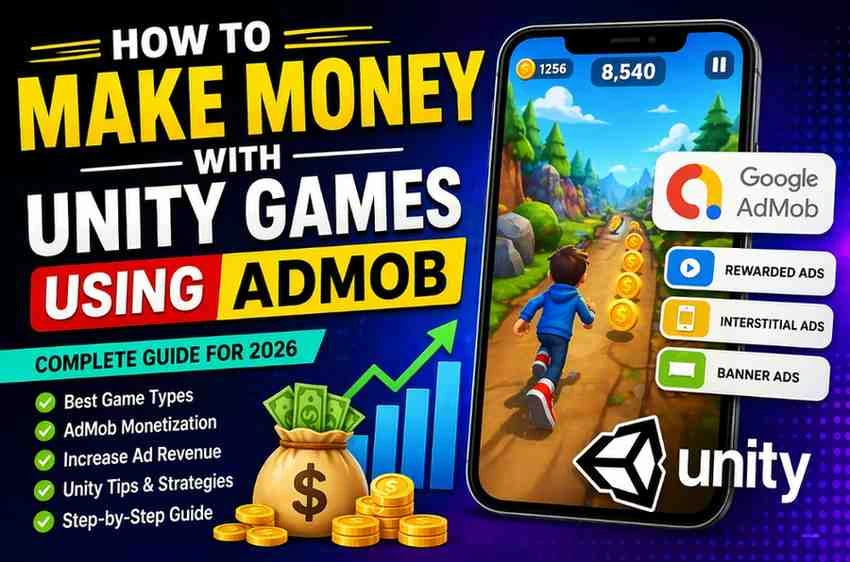
The mobile gaming industry crossed $100 billion in annual revenue and shows no signs of slowing down. Unity powers over 70 percent of the world's top mobile games. And Google AdMob alone processes billions of ad impressions inside mobile games every single day.
Here is the practical truth that most tutorials skip: you do not need to be an expert developer to make real money with Unity games in 2026. You need a proven game type, a smart monetization setup, and the fastest path from idea to published app.
This guide covers all three in exhaustive detail — the right game genres, the right ad strategies, the right revenue structures, the fastest development approach, and the specific Unity game templates you can use to get there. Whether you are researching how mobile game monetization works (informational intent) or actively looking for a Unity game source code to buy and publish right now (buy intent), everything you need is in this guide.
Before diving into strategies, let's establish why Unity is the right engine for monetizable mobile games — not just as a developer preference, but as a business decision.
Cross-platform from one codebase. A Unity project exports to Android, iOS, WebGL, PC, and console from the same source code. When you build a monetization system once in Unity, it works across every platform you deploy to. This dramatically reduces the cost per additional revenue channel.
The largest mobile game developer community in the world. More tutorials, more plugins, more forum answers, more third-party tools, and more asset store resources exist for Unity than for any other engine. This community support means solutions to problems are always findable, which keeps your development timeline moving and your revenue timeline shorter.
Native AdMob integration via the Google Mobile Ads Unity SDK. Google's own SDK is maintained for Unity and updated regularly. AdMob — the most widely used mobile game advertising network in the world — integrates into Unity projects with a well-documented SDK and clear implementation guides.
Unity's asset store reduces development cost dramatically. Vehicle physics, character animations, UI frameworks, particle effects, sound packs — they are all available immediately. This means your monetizable game reaches the Play Store faster and costs less to build.
Ready-made Unity source code accelerates revenue timelines even further. Rather than building from the Unity editor's empty scene, purchasing a complete, production-ready game template gets you to a publishable state in days rather than months. This is the single highest-leverage decision most indie developers and small studios can make.
If you want the full development context — from downloading Unity Hub to building your first APK — read the complete beginner resource: How to Make Games in Unity – Complete Beginner Guide for Mobile Game Development. This monetization guide assumes you already have a working Unity project or are choosing one — if you're earlier in the process, start there first.
AdMob is a mobile advertising platform owned by Google. It is free to use and integrated into the vast majority of revenue-generating mobile games globally. Here is exactly how the revenue mechanism works.
You register a free AdMob account. You create ad unit IDs for your game — one for each ad format you plan to use. You integrate these IDs into your Unity game using Google's Mobile Ads SDK. When your game is live on Google Play, AdMob serves real advertisements to your players from Google's advertising network.
You earn money based on impressions and interactions. Every time an ad is shown to a player, you earn a small amount based on CPM (cost per thousand impressions). Every time a player clicks an ad, you earn a higher amount based on CPC (cost per click). Every time a player completes a rewarded video ad, you earn the highest rates — because the advertiser paid for a completion, not just a view.
The revenue accumulates passively. Once your game is published and players are engaged, AdMob revenue arrives daily — whether you are working, sleeping, or building your next game. This is the core appeal of the mobile game monetization model: it scales without proportional additional work.
Rewarded Video Ads are the highest-earning format in mobile games. Players opt in to watch a 15-to-30-second video in exchange for an in-game reward — extra lives, coins, power-ups, or a chance to continue after failing. The opt-in nature means completion rates are near 100 percent, which commands the highest advertiser CPM rates. In puzzle and casual games, rewarded ads consistently generate 5 to 20 times more revenue per impression than banner ads.
Interstitial Ads are full-screen ads shown between natural gameplay breaks — between levels, after a game over, or when a player returns to the main menu. They do not require player interaction to close after a short timer. Interstitials earn well when placed at genuinely natural breakpoints and earn poorly (and damage retention) when placed intrusively. Frequency caps — showing no more than one interstitial every 90 seconds — are critical.
Banner Ads are persistent small-format ads displayed at the top or bottom of a screen during less active moments like the main menu or level select. They earn less per impression than rewarded or interstitial formats but generate passive background revenue throughout the session without any player interaction required.
The winning strategy: Prioritize rewarded ads as your primary revenue driver. Use interstitials at natural session breaks with strict frequency caps. Add banners to menus and loading screens for passive supplemental income.
Not all game genres generate equal AdMob revenue. The right genre choice is the most important single monetization decision you will make. Here is a detailed breakdown of the highest-performing categories.
Puzzle games are the most reliable category for AdMob revenue because they combine two things that advertising platforms love: long session times and natural monetization breakpoints.
Players in puzzle games are highly engaged. They have invested mental effort in a level and feel genuinely attached to completing it. When they fail — and puzzle games are designed so players do fail — a rewarded ad offering one more attempt converts at extraordinary rates. No other ad format in any other game genre converts as naturally or as consistently as a puzzle game's "continue for free" rewarded ad.
The HyperCasual Puzzle Game Engine (13 games in one package — $99) is one of the most valuable purchases in this entire guide. It includes 13 complete mini-game mechanics in one Unity project, all ready to publish and monetize. For developers who want to test multiple puzzle game concepts rapidly or launch a portfolio of casual titles quickly, this engine is exceptional value. Thirteen different AdMob-integrated gameplay systems for one purchase price.
Games built on precision throwing and targeting mechanics have a unique monetization advantage: they generate an extremely high number of attempts per session. Every missed throw is a potential retry. Every retry is a potential ad impression. The math works exceptionally well for AdMob.
The Blade Throw Unity Game Template ($99) — visible in the screenshot — is a complete, mobile-ready throwing game with unlimited levels, easy reskin architecture, and full monetization support. Blade throwing games have viral shareability — a perfect throw is satisfying enough to screenshot and share, which drives organic downloads. The unlimited level system means you can add content indefinitely, extending the game's lifespan and revenue period.
Tile-based jumping games occupy a unique position in the mobile gaming market. The mechanic is instantly graspable — jump on the tile, don't miss — but the precision required creates consistent failure states that naturally extend sessions as players retry. Retry loops are where interstitial ad revenue accumulates.
The Jump Tiles Unity Game Template ($99) — shown prominently in the screenshot — is a complete, ready-to-publish tile jumping game with unlimited levels, easy reskin architecture, and full monetization. The template's mobile-ready build settings and AdMob integration mean the only customization required before your first Google Play submission is a visual reskin and your ad unit IDs.
Word games attract an audience that is statistically older, more educated, and higher-earning than the average mobile game player. This demographic has two important characteristics for monetization: they respond exceptionally well to in-app purchases (they are willing to pay for a better experience), and they generate higher-value AdMob ad impressions because advertisers pay more to reach them.
Racing and action games generate strong session frequency — players return multiple times daily because they want to beat their previous record or their friend's score. This frequency is what drives consistent daily AdMob revenue, not just large single-session revenue.
For a complete breakdown of the highest-performing racing game types and the Unity templates that deliver them, read: Top Racing Game Source Codes in Unity – 2026 Complete Guide. It covers endless traffic racers, stunt car games, open world simulators, and multiplayer racing in full detail with monetization strategies for each.
Here is an honest timeline comparison that most guides avoid stating clearly.
Building a complete Unity mobile game from scratch: 3 to 6 months for a solo developer with intermediate Unity experience. This includes all gameplay systems, UI design and implementation, audio system, performance optimization, AdMob integration, and debug testing across multiple Android devices.
Launching from a ready-made Unity source code template: 1 to 3 weeks for the same solo developer. Core gameplay: done. UI: done. Audio: done. AdMob hooks: done. Optimization: done. Your time goes entirely into visual customization (reskinning), level design, and Play Store asset creation.
The revenue implication is direct: a game published in week three is earning money for five months before the from-scratch version is even complete. That is five months of daily AdMob revenue — potentially thousands of dollars — entirely attributable to the decision to use a ready-made template.
This is not about cutting corners. It is about allocating your development time to the parts that actually differentiate your game in the market — your visual identity, your level design, your marketing — rather than rebuilding systems that are already solved problems.
For a deeper exploration of this strategic choice, read: How to Learn Game Development Faster Using Complete Unity Projects and Best Unity Source Code Projects for Beginners in 2026 — two recent guides that lay out exactly how experienced indie developers use complete Unity projects to accelerate both learning and revenue.
These are the specific templates from the current catalog that represent the best combination of market demand, monetization potential, and launch speed.
Buy HyperCasual Puzzle Game Engine →
Thirteen complete hyper-casual puzzle games in one Unity package. Each game is independent, fully functional, ready to publish, and pre-integrated with AdMob. This is the single highest-leverage purchase for a developer who wants to test multiple game concepts rapidly or build a catalog of casual titles from one codebase. The variety means you can identify which game concept performs best with real Play Store data — then invest in developing that concept further. At $99 for thirteen publishable games, the cost per game is under $8.
Buy Blade Throw Unity Template →
A precision throwing game with unlimited levels, mobile-ready build configuration, easy reskin architecture, and complete monetization support. Blade throwing games consistently perform well on the Play Store because the mechanic is satisfying, the failure state is clear, and the retry impulse is strong — all of which drive high ad impression counts per session. The unlimited level system gives your published game indefinite content depth without additional development cost.
Buy Jump Tiles Unity Template →
A complete tile-jump game with unlimited levels, easy reskin, and full monetization. The tile-jump mechanic creates consistent, addictive retry loops that accumulate significant interstitial ad impressions per session. The Play Store has a proven audience for this genre, and this template's mobile-ready architecture means your time to publication is measured in days after reskinning.
Buy Color Block Jam 3D Puzzle →
A 3D color block sliding puzzle with challenging levels, easy reskin architecture, mobile optimization, and AdMob integration. Color block jam mechanics are currently at peak popularity on the Play Store — the timing to publish a quality version of this game type is excellent. The 3D presentation gives your published game visual differentiation from the many 2D competitors in the category.
Buy Color Escape Unblock Jam →
An unblocking escape puzzle variant of the color jam mechanic — players must slide blocks out of the way to create a clear path, adding directional challenge to the color-matching foundation. The escape framing creates urgency that drives stronger session focus and better ad engagement than purely relaxed puzzle formats. Ready to publish, easy to reskin, AdMob integrated.
Buy Color Block Jam 3D (Variant) →
A visual and level design variant of the Color Block Jam template, with different level structures and difficulty progressions. Useful for developers who want to publish two visually differentiated color block jam games targeting the same proven audience — a smart portfolio strategy for maximizing revenue from one well-performing mechanic.
Getting AdMob integrated is the beginning, not the end. These advanced strategies are what separate games earning $50 per month from games earning $2,000 per month with the same daily active user count.
AdMob Mediation connects multiple ad networks simultaneously and automatically serves whichever network is paying the highest CPM for every individual impression in real time. Without mediation, you are leaving money on the table every time a competing network would have paid more than AdMob's default fill.
Adding mediation partners like AppLovin MAX, ironSource, or Unity Ads to your AdMob setup can increase total ad revenue by 20 to 60 percent for the same user base with zero gameplay changes.
The same ad impression in the United States earns approximately 5 to 10 times more than the same impression in lower-eCPM markets. Your game's Google Play listing keywords and category targeting influence which markets your app is discovered in organically.
Including English-language store descriptions, targeting keywords that US and UK players search, and optimizing your Play Store metadata for tier-1 markets can meaningfully shift your user acquisition toward higher-value audiences — even without paid advertising.
Every percentage point improvement in Day 7 retention translates directly to higher lifetime AdMob revenue per install. A player who returns for seven consecutive days has seen your ads seven times rather than once.
Daily reward systems — especially streak-based ones where missing a day resets the reward progression — are the most cost-effective retention mechanism available. They require no ongoing content creation and no server infrastructure. They simply create a daily reason to open the app.
Offering a "Remove Ads" in-app purchase (typically $1.99 to $4.99) does three things: it generates direct IAP revenue, it identifies your most engaged players (the ones willing to pay), and it signals to Google Play's algorithm that your game generates real commerce — which can improve organic ranking.
The players who purchase Remove Ads are also your best candidates for additional IAP products — coin packs, power-up bundles, or cosmetic upgrades. Implement Remove Ads first; use purchase data to identify who your spenders are, then design additional IAP products for them.
The number of times per session a player willingly watches a rewarded ad is a direct function of how well your game design creates meaningful reward moments. A game where rewards feel consequential — where a revive actually saves a great run, where a coin doubler actually makes a meaningful difference to progression — generates 3 to 5 rewarded ad views per session.
A game where rewards feel trivial generates 0.5 views per session or fewer. This difference alone can represent a 6x to 10x difference in rewarded ad revenue for the same daily active user count. Invest in making your in-game rewards genuinely valuable — it is the most direct lever you have on rewarded ad revenue.
Here is a concrete, week-by-week plan that takes a developer from decision to daily earnings.
Week 1 — Choose and Purchase: Select the game template that matches your target market and audience. Purchase the Regular License. Download the project. Spend three days reading the code and playing the APK before changing anything.
Week 2 — Reskin Visual Assets: Replace character art, background assets, UI colors, and game name. Keep all code unchanged. The goal this week is making the game look like your game, not the template's game.
Week 3 — Configure AdMob: Create your AdMob account. Generate ad unit IDs for rewarded, interstitial, and banner formats. Replace test IDs in the project with your live IDs. Verify all ad formats display correctly in a test build.
Week 4 — Design and Add Levels: Use the included level editor or level data system to add your own custom levels. Aim for at least 50 levels before launch — enough content for a player to remain engaged for 7 to 10 days of casual play.
Week 5 — Test on Real Devices: Test on at least three different Android devices covering budget, mid-range, and premium tiers. Fix any performance issues. Play-test the complete level progression. Verify all ad placements trigger correctly.
Week 6 — Play Store Assets: Design your app icon. Create five screenshots. Record a 30-second gameplay video. Write your store description with target keywords. Research competitors to identify the right category and keyword strategy.
Week 7 — Submit and Launch: Upload your signed AAB to Google Play Console. Complete the store listing. Submit for review. Google Play review typically takes 2 to 5 business days for new apps.
Week 8 — Analyze and Iterate: Check AdMob dashboard daily. Review Google Play Console for install data, crash reports, and user ratings. Identify which levels have high drop-off and redesign them. Plan your first content update for week 10.
Building a complete understanding of Unity game monetization requires more than one article. These are the most valuable related resources on the site:
How to Make Games in Unity – Complete Beginner Guide — The essential starting point for the full development process from Unity Hub installation through Google Play submission.
Top Racing Game Source Codes in Unity – 2026 Guide — Deep coverage of the racing game category with monetization strategies, feature requirements, and template recommendations for every racing game sub-genre.
How to Learn Game Development Faster Using Complete Unity Projects — How experienced developers use complete source code projects to accelerate both skill development and time to market.
Serving interstitial ads too frequently. If a player sees an interstitial ad every 30 seconds, they uninstall. A player who uninstalls earns you nothing for the rest of their life. Frequency caps of one interstitial per 90 to 120 seconds are the professional standard.
Placing ads during active gameplay. Interstitials should never appear while the player is actively playing. Only between levels, after game-overs, or when returning to menus.
Skipping AdMob mediation. Mediation is free to set up and consistently increases revenue by 20 to 60 percent. There is no valid reason to leave it unconfigured.
Ignoring ASO entirely. A game that nobody finds generates no ad revenue regardless of how well-built it is. Your Play Store listing, keywords, screenshots, and video preview are all discoverable by Google's algorithm. Invest one day in proper ASO before submission.
Not testing on budget devices. A game that runs perfectly on a flagship phone but stutters on a budget Android will get one-star reviews that permanently damage discoverability. Test on the cheapest Android device you can find before submitting.
Publishing once and abandoning. Google Play's algorithm rewards apps that receive regular updates. A content update — even just 10 new levels — signals active maintenance, which improves ranking and can meaningfully increase organic installs months after launch.
The barrier to making money with Unity games in 2026 is not technical skill. It is not creative ability. It is not access to tools. All of these are widely available.
The barrier is the gap between knowing how to do something and actually doing it — and the decision to use a ready-made Unity game source code as your starting point eliminates the largest portion of that gap.
Choose a proven game type. Purchase a complete, well-built template. Reskin it with a distinctive visual identity. Design thoughtful levels. Configure AdMob correctly with rewarded, interstitial, and banner placements. Publish. Analyze. Iterate.
This is exactly the workflow that generates daily passive AdMob income from mobile games. It is not complicated. It is simply a matter of executing it.
Browse all Unity game source code templates → and find the one that fits your target market, your skills, and the audience you want to build for.



