

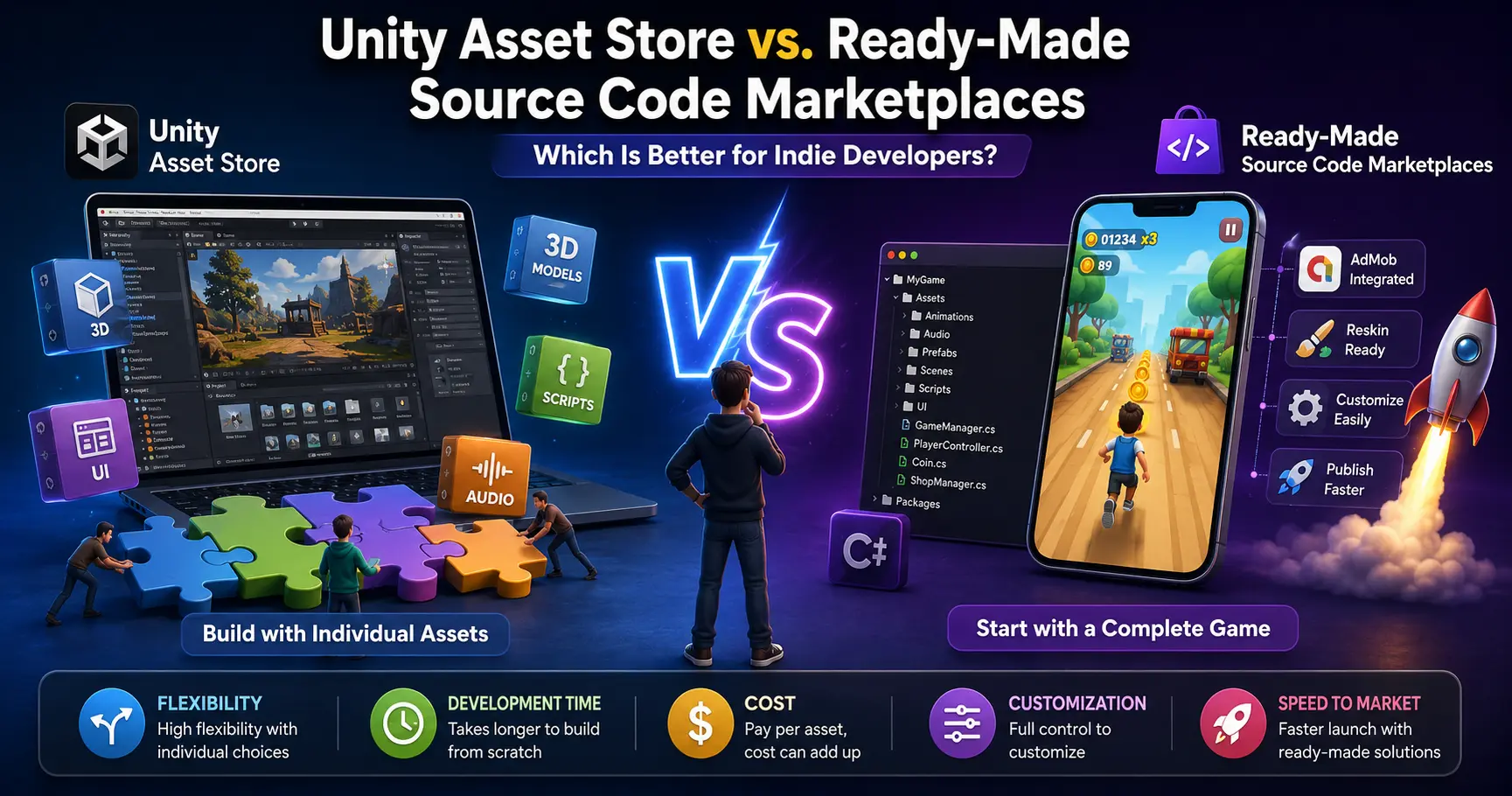
Every indie game developer eventually asks the same question: should I build my game from scratch, buy individual assets, or just purchase a ready-made source code and reskin it? This decision can make or break your development timeline, your budget, and ultimately your revenue.
Two of the most popular routes indie developers take today are the Unity Asset Store and ready-made Unity source code marketplaces. Both promise to save you time and money, but they work in very different ways — and choosing the wrong one can cost you months of wasted effort.
In this in-depth guide, we'll break down exactly what each option offers, compare them across cost, quality, customization, licensing, and profitability, and help you decide which path fits your goals as an indie developer in 2026.
The Unity Asset Store is Unity Technologies' official digital marketplace where developers can buy and sell individual game development components. Think of it as a supermarket of building blocks — 3D models, textures, sound effects, scripts, plugins, shaders, and UI kits — all designed to plug into your Unity project.
It's an excellent resource if you're building a game from the ground up and need specific pieces: a character controller, a particle effect pack, an inventory system, or a networking plugin. Developers pick and choose assets, then stitch them together inside their own custom codebase.
Strengths of the Unity Asset Store:
Limitations:
Ready-made source code marketplaces, on the other hand, sell complete, functioning games — not just individual pieces. You get the full Unity project: gameplay mechanics, UI, monetization hooks (ads and in-app purchases), and often documentation on how to publish it.
This is where platforms like unitysourcecode.net come in. Instead of assembling a game piece by piece, developers can browse a catalog of finished templates — hyper-casual games, puzzle games, hybrid-casual projects — and simply reskin them with new art, sounds, and branding before publishing to the app stores.
For example, a developer could buy something like the Bus Mania Jam Unity game template or the Farm Village Unity source code, swap in new visuals, and have a store-ready build in days rather than months. Puzzle-focused developers might instead look at something like the Snake Escape puzzle game source code as a base for a quick, low-risk release.
Strengths of ready-made source code:
Limitations:
| Factor | Unity Asset Store | Ready-Made Source Code Marketplaces |
|---|---|---|
| What you get | Individual components | Complete, playable game |
| Development time | Weeks to months | Days to weeks |
| Coding skill required | Moderate to high | Low to moderate |
| Customization depth | Very high | High (via reskinning) |
| Monetization setup | Manual | Often pre-integrated |
| Best for | Building unique, original games | Fast launches and portfolio building |
| Risk of market saturation | Low | Moderate (if template is popular) |
This table captures the core tradeoff: the Unity Asset Store gives you raw ingredients, while source code marketplaces give you a finished meal you can season to taste.
Cost is rarely a simple apples-to-apples comparison because you're not just paying for files — you're paying for time saved and risk reduced.
On the Unity Asset Store, you might spend $20–$100 on a handful of assets, but you'll also invest dozens (sometimes hundreds) of hours writing glue code, debugging integrations, and building systems that don't exist off-the-shelf. If you're a solo developer without a team, that time has a real opportunity cost — every week spent coding core mechanics is a week not spent marketing, polishing, or shipping your next title.
Ready-made source code, by contrast, usually costs more upfront per project (often ranging from double to several times the price of a single asset pack), but it replaces weeks of engineering work. When you calculate cost per hour saved, a complete template frequently comes out ahead — especially for developers who plan to reskin and republish multiple games as part of a volume-based strategy.
Bottom line: If your time is limited and you want to publish frequently, ready-made source code typically offers a better return on investment. If you have strong programming skills and plenty of time, the Asset Store can be more economical.
Speed matters enormously in the mobile game industry, where trends shift quickly and being first (or fast) to a niche can determine success. Hyper-casual and hybrid-casual genres in particular reward developers who can test ideas rapidly and iterate based on real player data.
Building from scratch using Asset Store components can realistically take anywhere from one to six months, depending on complexity. You need to design systems, integrate assets, test compatibility, and debug constantly.
Ready-made source code compresses this dramatically. A well-documented template can go from purchase to store submission in a matter of days. If you're targeting iOS specifically, resources like how to launch a Unity game on iOS in 2026 walk through the exact submission process, so the only real bottleneck becomes reskinning and store approval — not development.
This speed advantage is why so many successful mobile studios rely on a "buy, reskin, launch, repeat" model rather than building every title from zero.
A common misconception is that ready-made source code means a generic, cookie-cutter game. In reality, reskinning is both an art and a science — and it's one of the most valuable skills an indie developer can learn.
Reskinning involves changing the visual theme, sound design, UI, character models, and sometimes level progression of an existing game template, while keeping the underlying (already tested) gameplay mechanics intact. Done well, a reskinned game feels completely original to players.
If you want to go deeper, our guide on how to reskin a Unity game template covers the entire process step by step — from swapping art assets to adjusting difficulty curves so your version stands out from the source template.
The Asset Store, meanwhile, offers deeper customization at the code level since you're building the architecture yourself. This is ideal if your game concept relies on a truly novel mechanic that doesn't exist in any pre-made template. But for genres like hyper-casual, endless runners, or puzzle games — where the core loop is already well established — reskinning a proven template is often more efficient than reinventing the wheel.
For inspiration on genres that reskin particularly well, check out the top hyper-casual Unity game source codes of 2026.
Quality control is one of the biggest differentiators between these two options.
On the Unity Asset Store, quality varies enormously between publishers. Some assets are meticulously documented and actively maintained; others are abandoned after a single Unity version update. Since you're combining assets from multiple sellers, compatibility issues are common, and support is scattered across different publishers with inconsistent response times.
Reputable ready-made source code marketplaces tend to offer more consistent quality because the entire game — not just isolated pieces — has already been built, tested, and often published successfully at least once. Good marketplaces also provide setup documentation, feature lists, and sometimes direct support for buyers integrating features like ads, in-app purchases, or leaderboards. For example, if you're adding competitive or retention features, a resource like how to add leaderboards and achievements can walk you through Unity's Gaming Services integration on top of your purchased template.
Tip: Always check reviews, changelogs, and update history before buying — whether you're browsing the Asset Store or a source code marketplace. A well-supported product saves you far more time than a cheap one that breaks with the next Unity LTS release.
Licensing is where many new developers get tripped up, so it's worth understanding clearly.
Unity Asset Store licenses are typically governed by Unity's standard Asset Store EULA, which usually allows use in one or multiple end products depending on the license tier (Personal vs. Pro assets). Most assets can't be resold as standalone products — you can only use them within a game you build and publish.
Ready-made source code marketplaces usually offer a commercial license that allows you to modify, rebrand, and publish the game as your own — but typically restricts reselling the raw, unmodified source code to other developers. Some marketplaces also offer exclusive or extended licenses if you want sole ownership rights to a specific template.
Before purchasing from either type of platform, always read the license terms carefully regarding:
This is the question every indie developer really cares about. The honest answer: it depends on your strategy, but ready-made source code has a proven track record for developers pursuing a volume-based, ad-monetized mobile strategy.
Because templates come with tested, market-validated gameplay loops, developers can focus their energy on reskinning, marketing, and ASO (App Store Optimization) rather than debugging core systems. This lets solo developers and small teams publish multiple titles per month instead of per year — and in the mobile games industry, publishing volume directly correlates with the odds of hitting a breakout success.
If you're curious about realistic earning potential, our detailed breakdown on how much you can earn selling a reskinned Unity game explains real revenue ranges based on ad networks, IAP conversion, and platform (Android vs. iOS).
The Unity Asset Store approach can also be profitable, especially for developers building a genuinely unique, high-quality game with strong retention mechanics — but it generally requires a longer runway before you see revenue, since development itself takes longer.
If you're leaning toward mobile publishing specifically, resources like best ready-made Unity games for Android can help you identify templates already optimized for the Android ecosystem, where hyper-casual and casual genres dominate downloads.
Here's a simple decision framework to help you pick the right approach:
Many successful indie developers actually use a hybrid approach — starting with a ready-made source code base for speed, then supplementing it with individual Unity Asset Store plugins (analytics tools, ad mediation SDKs, or leaderboard systems) to extend functionality without rebuilding the core game.
Q: Can I sell a reskinned Unity template as my own game? Yes, as long as the license permits commercial use and modification, which most reputable marketplaces offer. Always confirm the specific license terms before publishing.
Q: Is it legal to buy a Unity source code and republish it under a different name? Yes, provided you have a commercial or extended license. This is a standard, legitimate practice in the mobile game industry, often referred to as "reskinning."
Q: Will Google Play or the App Store reject a reskinned game? Not inherently — but stores do scrutinize spam-like, low-effort duplicates. Meaningful visual, audio, and gameplay-tuning changes, along with proper store metadata, help ensure approval. The iOS launch guide covers store compliance in more detail.
Q: Do I need coding experience to use ready-made source code? Basic Unity familiarity helps, but most reputable templates are built to be beginner-friendly, with clear folder structures and setup documentation.
Q: Can I combine Unity Asset Store assets with a ready-made source code project? Absolutely. Many developers add Asset Store plugins (like ad networks, analytics, or UI polish tools) on top of a purchased source code template for the best of both worlds.
So, which is better for indie developers — the Unity Asset Store or ready-made source code marketplaces?
There's no universal winner; it comes down to your priorities. The Unity Asset Store is best suited for developers who want maximum creative control, are building a genuinely original concept, and have the coding skill and time to bring it to life piece by piece.
Ready-made source code marketplaces are best suited for developers who prioritize speed, want proven and monetization-ready gameplay, and aim to publish frequently rather than spend months on a single title. For most solo indie developers and small studios operating in the competitive hyper-casual and hybrid-casual mobile space, ready-made source code offers a faster, lower-risk path to market — and often, faster revenue.
If you're ready to skip months of development and launch your next mobile hit quickly, browse the full catalog of Unity game source codes and templates to find a proven game concept you can make your own today.



