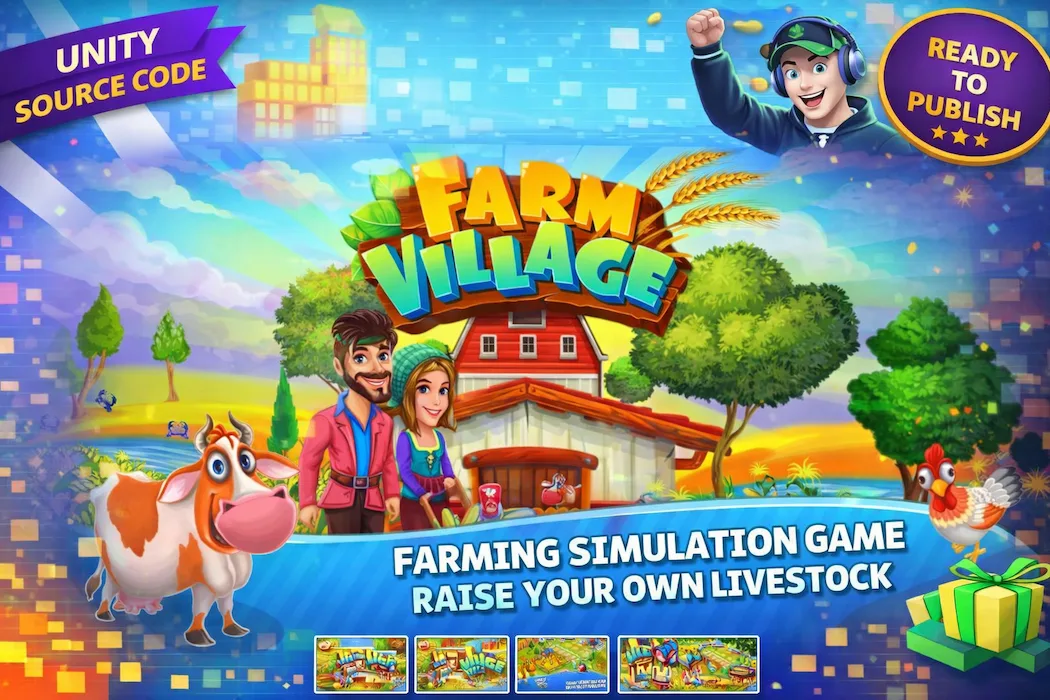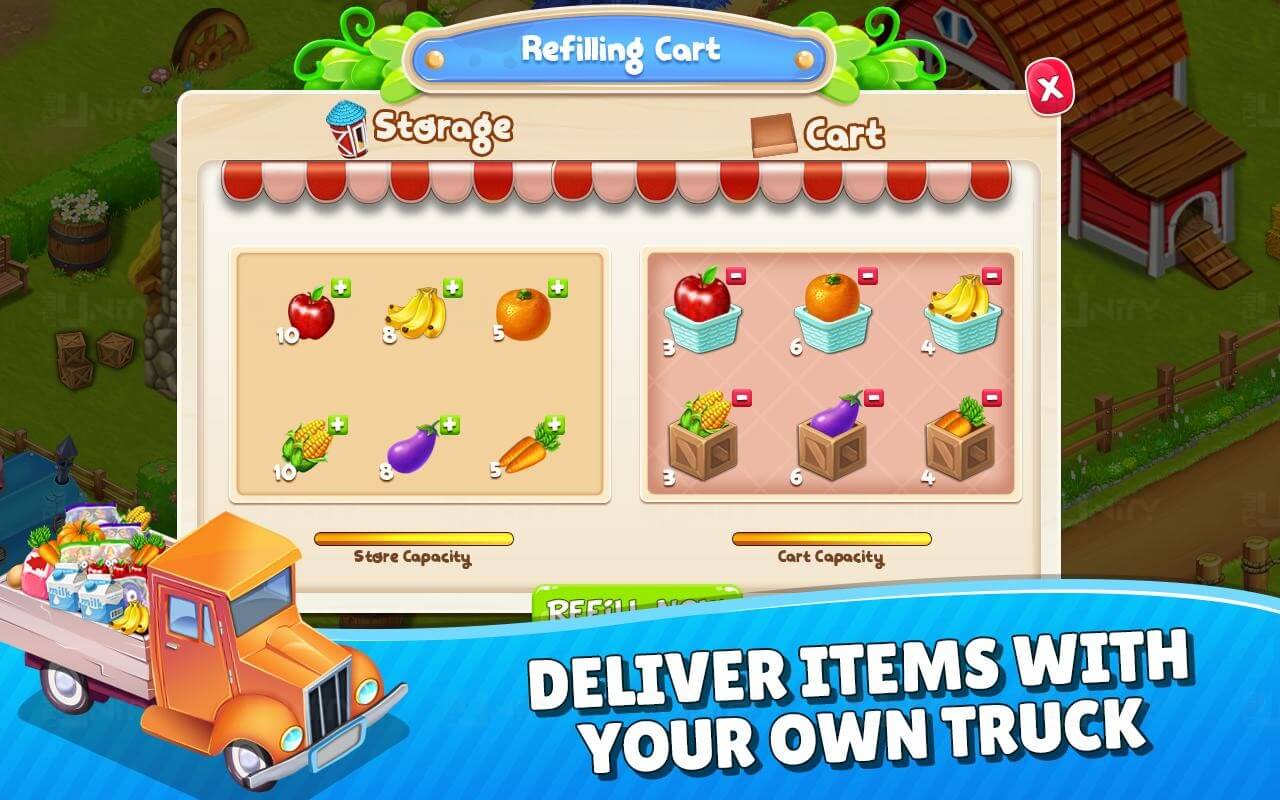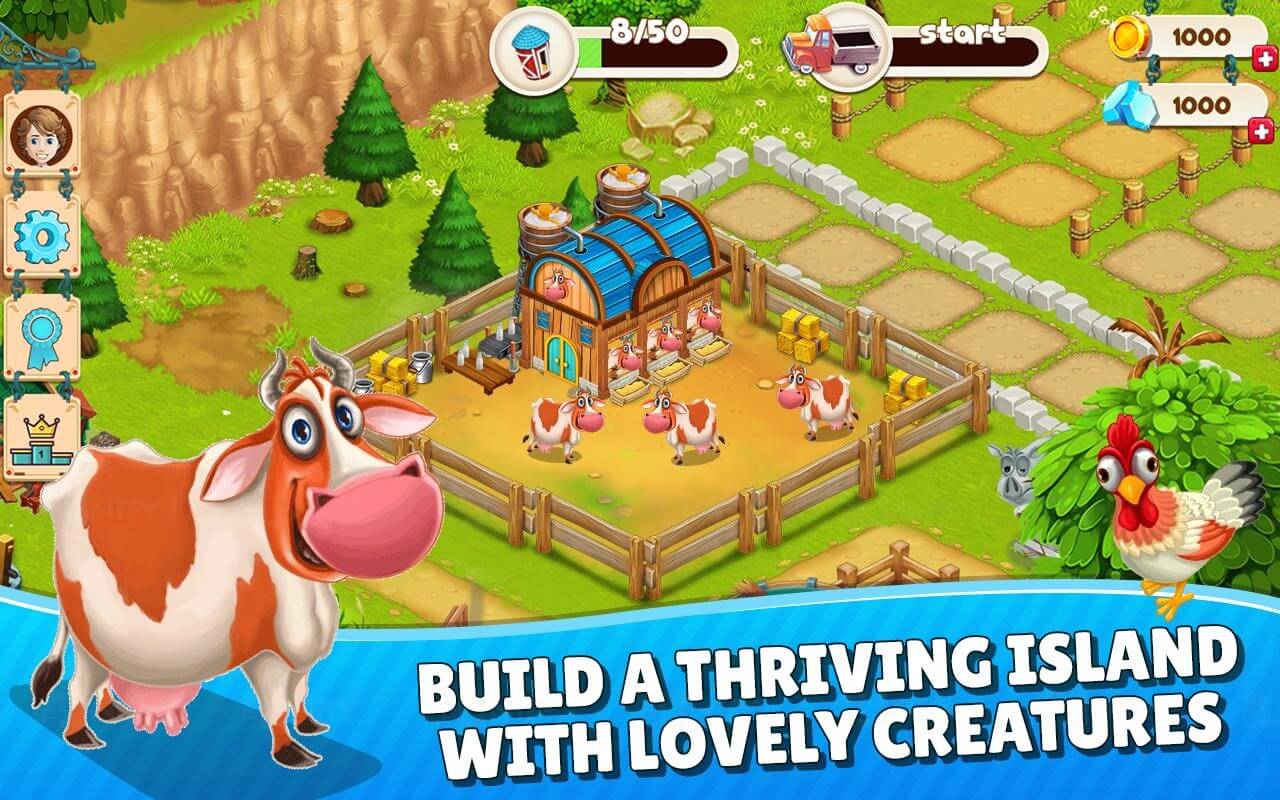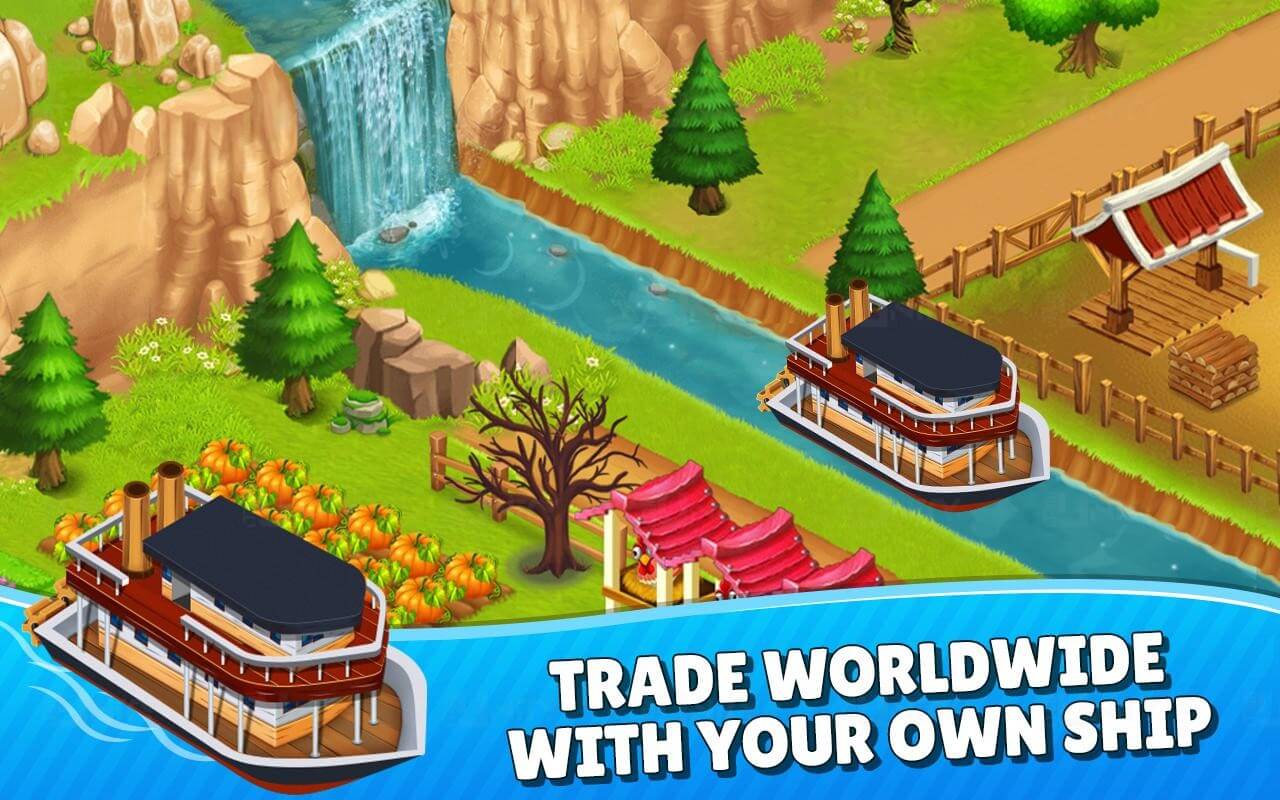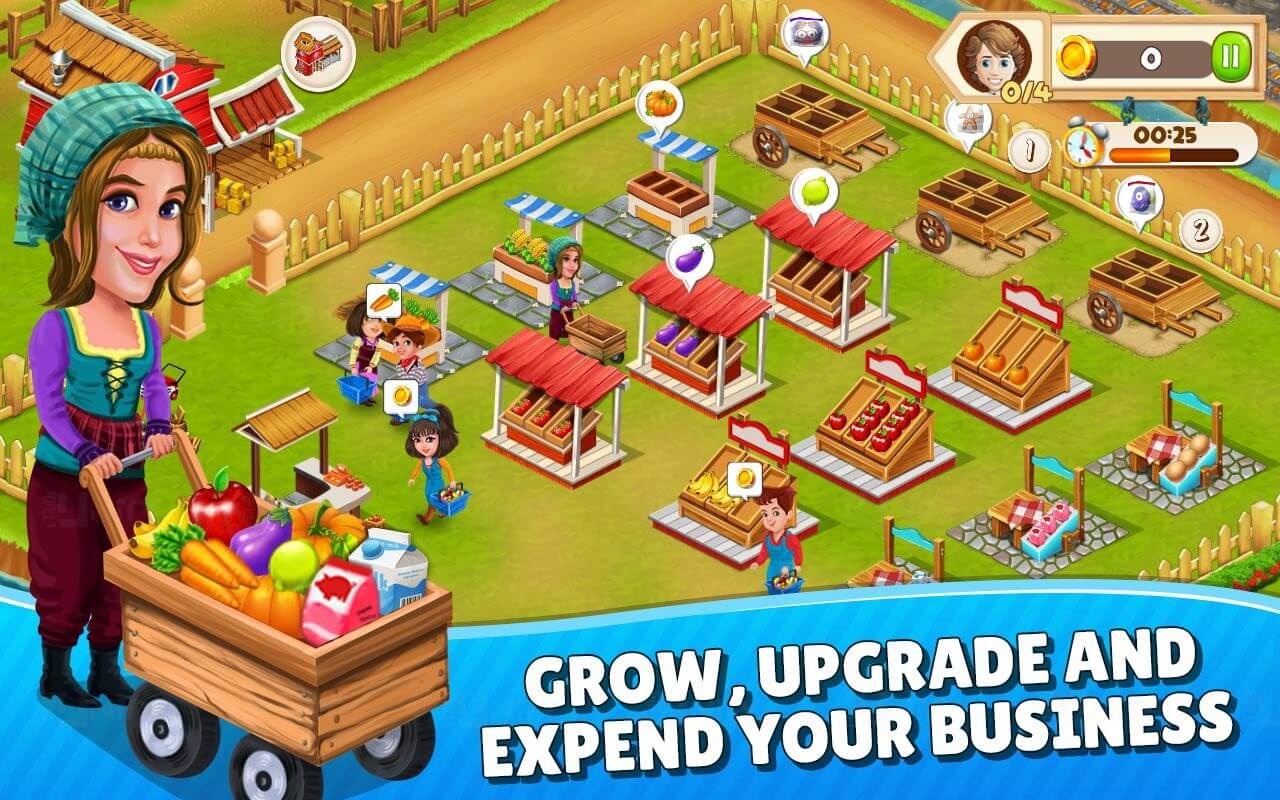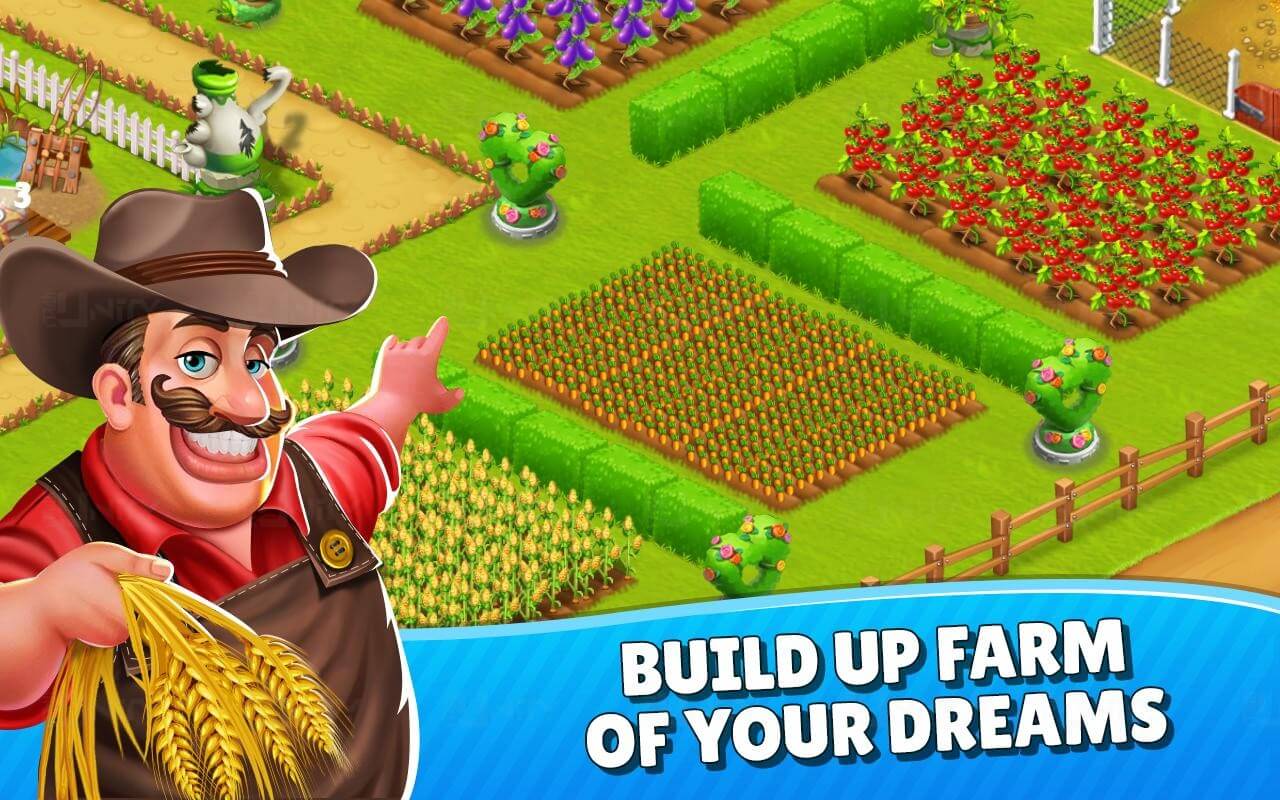

Farming simulation games have long held a special place in mobile gaming because they combine relaxing pace with genuine long-term progression. But building a simulation game with multiple interconnected systems — crops, livestock, construction, and a balanced in-game economy — is a far bigger undertaking than a typical casual title. Farm Village Unity Source Code solves that challenge by giving developers a complete, ready-to-customize Unity farming simulation template that already combines all these systems into one cohesive gameplay experience.
Whether you're an indie developer planning a full-featured simulation release, a studio expanding your portfolio of casual titles, or an entrepreneur searching for a proven Unity farm building game template to reskin and publish, Farm Village gives you a robust, monetization-ready foundation to launch from.
Farm Village is a full-featured Unity farming ecosystem designed for developers who want more than a single-mechanic game. Instead of focusing on just crops or just animals, this template weaves farming, animal care, construction, and resource management into one interconnected simulation. Every system talks to every other system — crops feed animals, animals generate resources, resources fund construction, and construction unlocks new gameplay possibilities.
Rather than spending months architecting and balancing these systems from scratch, you get a fully structured, developer-friendly Unity codebase that's already built and ready for customization. It's a strong technical foundation for building a long-term, engagement-driven mobile farm simulation game for Android and iOS.
What sets Farm Village apart from simpler farming templates is that it's built as a genuinely dynamic system, where every element connects to the next.
This interconnected design is what makes Farm Village feel like a complete farm-life simulation rather than a shallow crop-tapping loop.
Rather than offering a single linear loop, Farm Village layers three core systems on top of each other for real gameplay depth.
Each of these systems adds its own layer of variety, and together they create a simulation with genuine strategic depth — the kind of layered progression you'll also find in genre-blending word and puzzle titles like Word Stacks, where multiple small mechanics combine into one satisfying core loop.
Growth in Farm Village is driven by continuous, visible expansion, which is one of the strongest retention mechanics in the simulation genre.
This steady sense of advancement keeps players invested well beyond their first session, encouraging the kind of daily return visits that publishers look for in a successful mobile release.
Farm Village includes a balanced in-game economy that adds a genuine strategic layer on top of the core farming loop.
This economic layer transforms simple resource collection into meaningful decision-making, giving players a reason to think several steps ahead rather than just tapping through routine tasks.
Unlike hyper-casual games built for quick, disposable sessions, Farm Village is architected for sustained, long-term engagement.
This design philosophy makes Farm Village particularly well-suited to simulation game audiences who value depth and progression over fast, throwaway sessions — a very different pace from quick-fix word puzzle games like Word Search, though both genres share the same underlying goal of keeping players coming back.
Farm Village pairs its layered systems with a clean, pleasant user experience designed to keep management simple even as the farm grows more complex.
This combination of visual warmth and interface clarity keeps the game immersive without ever feeling overwhelming, even as players juggle crops, animals, and construction projects at the same time.
Farm Village isn't just built to play well — it's structured for developers who need to scale and customize efficiently.
This clean, modular architecture means you can rework individual systems without untangling the entire codebase — a development approach that mirrors other well-structured Unity templates such as Word Link, where each gameplay module is similarly easy to isolate and customize.
Simulation games are known for strong monetization potential, and Farm Village is built with several revenue streams ready to go.
This flexibility makes Farm Village suitable for a wide range of business models, whether you're targeting a free-to-play mobile audience or building toward a more premium release.
Farm Village is designed as a foundation you can grow into a complete farm universe over time.
Developers who enjoy building out layered progression systems may also want to explore how word-based mechanics scale over time in titles like Wordy – A Wonderful Word Unity Game, which follows a similar principle of starting simple and expanding gameplay depth through updates.
Farm Village stands out as a genuinely complete simulation package rather than a single-mechanic template.
If you're weighing this deep simulation format against faster, more casual genres before choosing your next project, it's worth comparing Farm Village to something like Zen Piano, a rhythm-based title that delivers a very different, quick-session style of engagement — useful context when deciding which genre best matches your target audience and release timeline.
Before committing significant development time to any template, it's worth thinking carefully about genre fit, target audience, and long-term scalability. Our guide on how to choose the right Unity game genre walks through the key factors developers should weigh — from market demand to development complexity — before settling on a project.
It's equally important to understand how budget-friendly, pre-built templates like Farm Village fit into a realistic indie development strategy. Our article on how budget Unity templates help indie developers explains how starting from a proven codebase — rather than building every system from zero — can dramatically shorten your path to a published, revenue-generating game.
Farm Village Unity Source Code – Farming Simulation Game with Animals, Building System & Full Game Features is more than just a template — it's a complete game framework. With its interconnected systems, scalable architecture, and strong engagement mechanics, it gives developers everything needed to build a full-featured farming simulation that can grow steadily over time.
If your goal is to create a deep, expandable, and genuinely profitable farming simulation game, this Unity project is an excellent foundation to build on. You can also browse our full collection of newest items to see the latest templates added to the Unity Source Code library.
1. What Unity version is Farm Village built with? Farm Village was originally built on Unity 2019.1.14f1, with the current version updated to Unity 2021.2.7f1, keeping it compatible with modern Unity development workflows.
2. What core systems does Farm Village include? The template combines three main systems — farming, animal management, and building/construction — all connected through a shared resource economy for a genuinely layered simulation experience.
3. Is Farm Village suitable for developers new to simulation games? Yes. Despite its multiple interconnected systems, the codebase is modular and clearly organized, making each system easy to understand, modify, and expand independently.
4. Can I add new crops, animals, or buildings? Absolutely. The modular C# architecture is specifically designed to let you add or modify crops, animal types, and buildings without needing to rebuild core systems from scratch.
5. Does Farm Village support monetization? Yes. It's built to support rewarded ads, interstitial-style ad placements, in-app purchases, premium customization options, and event-based monetization strategies.
6. What platforms does this template support? Farm Village is fully optimized for mobile performance and supports both Android and iOS, with a UI designed for smooth on-the-go farm management.
7. Can I expand Farm Village into a larger game over time? Yes. The template's expandable architecture supports adding trading systems, seasonal events, multiplayer or social features, quests, and decoration/customization systems as your game matures.
8. What kind of support comes with the purchase? Depending on the license selected, you'll receive future updates and either 3 or 6 months of support, along with quality assurance checks performed by the Unity Source Code team.
You need to login to comment!
Total Sold:
0
Total Comments: