

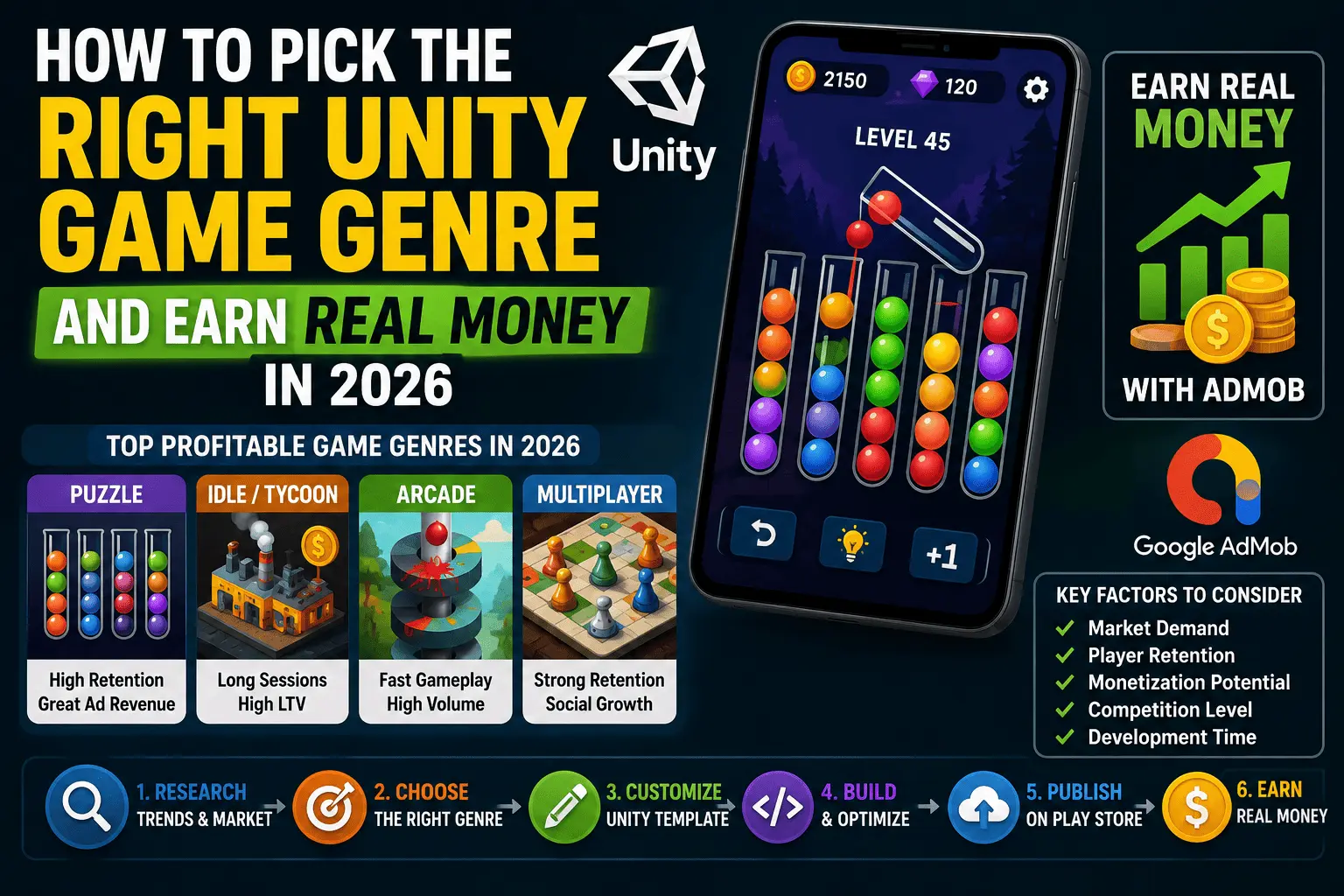
Most Unity developers make the same costly mistake early in their career — they pick a game genre they personally love rather than one the market actually rewards. The result? Months of development, a polished launch, and then silence. No downloads, no ad revenue, no momentum.
The good news is that in 2026, the relationship between genre choice and revenue is clearer than it has ever been. App store data, ad network payouts, and player retention benchmarks all paint a remarkably consistent picture of which game types genuinely make money and which ones look good on paper but underperform in the wild. This guide breaks that picture down honestly, pairs each winning genre with a ready-made Unity game source code template you can actually launch, and gives you the strategic lens to stop guessing and start building with confidence.
Before you write a single line of C#, the genre decision shapes everything downstream — development complexity, monetization ceiling, target audience, store category competition, and the kind of player reviews you will receive six months after launch.
Developers who choose poorly often realize the problem too late. They have invested weeks in a mechanic that, even if perfectly executed, lives in a genre with low eCPMs, poor session lengths, or brutal competition from well-funded studios. The smarter path is to choose a genre with proven market fit first, then bring your creative energy to the execution.
If you want a deeper look at why ready-made templates accelerate this whole process, our guide on why ready-made Unity source code can speed up game development in 2026 explains the mechanics behind that time advantage.
Idle games occupy a uniquely profitable corner of mobile gaming. Players open the app, tap a few times, collect offline earnings, and close it again. Session lengths are short, but daily return rates are extraordinarily high — often exceeding 40% after day seven. That retention profile translates directly into ad impressions per user, which is what AdMob pays you for.
The business model in idle games tends toward rewarded video ads rather than banners. Players watch ads to double their offline earnings, speed up upgrades, or unlock premium buildings. Because the player is choosing to watch rather than being interrupted, completion rates on rewarded ads in idle games consistently outperform those in other genres, and eCPMs in this category frequently run between $8 and $18 per thousand impressions in tier-one markets.
The biggest barrier to entry used to be the complexity of building idle economy systems from scratch — offline calculation, prestige mechanics, upgrade trees, and save state management. A ready-made template eliminates that barrier entirely.
The Idle Market Tycoon Unity Source Code is built precisely for this opportunity. It is a complete 3D idle business simulation with AdMob integration already wired in, IAP support for coin packs and premium upgrades, and an offline earnings engine that handles the complex time-delta calculations automatically. The visual style uses a top-down market scene with animated characters and goods movement, giving it the production value players expect from games in this genre. At $69 (marked down from $139), the entry cost is negligible compared to the revenue ceiling.
The Archero format — top-down auto-shoot gameplay with randomized ability selection between waves — has proven to be one of the stickiest mobile game mechanics of the last several years. Players return because no two runs feel identical, and the progression loop of unlocking characters, gear, and stages creates genuine long-term engagement.
From a monetization standpoint, action games like this support a hybrid model particularly well. Ad revenue comes from interstitials between runs and rewarded ads for revival attempts. In-app purchases cover cosmetic equipment, hero unlocks, and energy refills. Studios that execute this combination competently routinely report ARPU (average revenue per user) figures that dwarf pure casual titles.
The development challenge has historically been building the projectile and enemy systems, the ability-selection UI, and the wave-scaling difficulty curves in a way that feels fair. Done poorly, runs feel random rather than strategic, and players disengage.
The Archero Style Unity Game Source Code delivers a complete mobile game in this format with AdMob integration already set up. The project includes multiple playable heroes, an ability selection system between waves, enemy AI, and a stage-based progression structure. At $49 (reduced from $199), it represents a serious shortcut into one of mobile gaming's highest-ARPU genre categories.
If you are earlier in your journey and want context on which projects build the right foundational skills first, read our guide on the best Unity projects for new developers before diving into action mechanics.
Strategy and tower defense games attract a player segment that is notably more willing to spend money than casual puzzle audiences. These players engage with deeper systems, tolerate longer session requirements, and respond strongly to prestige mechanics and competitive leaderboards.
Tower defense specifically has seen a resurgence on mobile in 2026, partly because the format adapts naturally to short-session play. A single wave defense encounter takes two to four minutes, which fits mobile gaming patterns well. Players who enjoy it often develop habitual engagement — checking in multiple times per day to upgrade towers, try new wave compositions, and push further into campaign content.
Monetization in this category frequently uses an energy system (rewarded ads to refill energy instantly), premium tower or hero unlocks via IAP, and battle pass structures for high-engagement players. eCPMs are competitive because the audience demographic skews older and more affluent than hyper-casual titles.
The Gear Master Unity Game – Tower Defense Strategy & Tactical Battle Template is a complete, ready-to-publish strategy game template. It includes a tower placement system, enemy pathing, wave progression, and a tactical upgrade loop — all the systems that take the most time to build from scratch. The $49 price tag makes it accessible to indie developers testing this genre for the first time.
The crowd runner format — where you merge units while running through a level to build up an army for a final combat encounter — emerged as a genuine phenomenon over the past two years and has not cooled down. New entries in this genre regularly chart on both Google Play and the App Store, and the format has proven highly compatible with AdMob interstitial monetization because natural breaks occur between levels.
What makes this genre particularly attractive for indie developers is its relatively straightforward core loop: run, collect, merge, fight. The visual spectacle of a growing crowd gives players immediate dopamine feedback without requiring complex skill execution. That accessibility translates into strong download conversion from store listings and strong early retention figures.
The Last War Survival Battle – Crowd Runner & Combat Unity Game Template captures this format completely. The template includes crowd merging mechanics, lane-based running, enemy combat at the end of each level, and a progression system with upgrade loops. Rated five stars by buyers, at $99 it is one of the more premium templates on the platform — and one of the most popular, sitting in the top items by engagement.
You can browse more templates across all these genres directly on the all games page.
This one surprises developers who have not looked at the numbers. Interior design and home makeover games consistently outperform expectation in both retention and monetization. The audience skews female, aged 25 to 45, which is one of the highest-value demographic segments for mobile ad revenue and IAP spending.
The core loop — receive a renovation task, make design choices, earn stars, unlock story progression — sounds simple. The execution that makes top titles in this space succeed is the emotional investment players develop in their virtual properties. That emotional investment drives return visits and willingness to spend.
Advertising in this genre supports both rewarded and interstitial formats well. IAP works through coin packs used to unlock premium furniture and decor sets. The combination can generate consistent daily revenue without requiring the viral growth spikes that hyper-casual titles depend on.
The Home Design Makeover Unity Game Source Code includes a complete interior design game loop with room renovation tasks, star rating mechanics, and a progression system. At $79 (down from $199), and carrying a strong five-star buyer rating, it is one of the most proven templates on the platform for developers targeting this lucrative demographic.
Picking the right genre is step one. Monetizing it correctly is step two, and where most indie developers leave significant money on the table.
Every genre discussed in this guide supports AdMob integration, and most Unity templates from unitysourcecode.net come with AdMob already wired in. But the placement strategy matters as much as the integration itself. For a full breakdown of how to maximize AdMob income per install, our guide on how to make money with Unity games using AdMob walks through placement strategy, format selection, and eCPM benchmarks by genre in detail.
The short version: rewarded ads belong wherever players face a meaningful setback or desire a shortcut — revival after death, offline earnings multiplier, unlocking a locked area. Interstitials belong at natural pause points — between levels, after a run ends, after the player leaves a sub-menu. Banners have the lowest eCPM but run constantly, making them useful as a passive baseline layer that doesn't interrupt gameplay.
In-app purchases work best when they align with player psychology in the specific genre. Idle games sell time compression. Action games sell cosmetics and power. Strategy games sell army or tower packs. Design games sell premium decor. Forcing a purchase model from one genre into another almost always underperforms.
Not all source code templates are built equally. Before purchasing any template, check for these signals of quality:
The Unity version listed on the product page should be a recent LTS release or a version you already have installed. Compatibility warnings add friction to your workflow, especially when you are trying to move quickly from purchase to customization to launch.
Look for AdMob integration included in the base package. Retrofitting ad SDKs into a project that wasn't designed for them wastes days and introduces bugs. The best templates from the bestseller collection include monetization out of the box.
Check whether the asset list includes everything needed to build and run without third-party dependencies. A complete package with all sprites, audio, prefabs, and scripts means you can open the project and hit Play without hunting for missing references.
Finally, look for templates that have been tested on real Android devices, not just in the Unity editor. Mobile performance behavior diverges significantly from editor preview, and a template that has been validated on hardware is far less likely to produce frame-rate complaints in your app store reviews.
For developers who want to explore entry-level options before committing budget, the free items section includes several complete game templates available after registration — a useful way to evaluate code quality before purchasing a premium project.
The developers earning consistent revenue from Unity games in 2026 are not releasing one game and waiting. They are building genre portfolios — two or three games in adjacent niches that share an audience, using templates to compress the production cycle for each title.
This approach works because cross-promotion becomes possible once you have multiple live titles. A player who enjoys your idle tycoon game is a warm audience for your tower defense title. A push notification to your crowd runner player base announcing a new survival game costs nothing and converts at multiples of cold traffic.
The templates available through trending items and flash sale collections make this portfolio approach financially realistic for solo developers. Instead of eighteen months building one game from scratch, the same investment in time and budget can produce three launched games — each generating ad revenue, each building a user base that feeds the next.
Genre selection in Unity game development is not a creative constraint — it is a strategic advantage. Developers who understand which genres are actually generating revenue in the current market, and who equip themselves with professional-grade templates to execute in those genres quickly, operate with an enormous structural advantage over those who build entirely from scratch in uncertain categories.
The five genres covered in this guide — idle/tycoon, action roguelite, tower defense/strategy, crowd runner survival, and home design simulation — all have demonstrated, measurable track records of delivering real revenue to real developers in 2026. Each has a ready-made Unity source code template available today that eliminates the most time-consuming parts of development.
Explore the full Unity game source code collection to find the template that matches your genre of choice, and go build something that earns.



