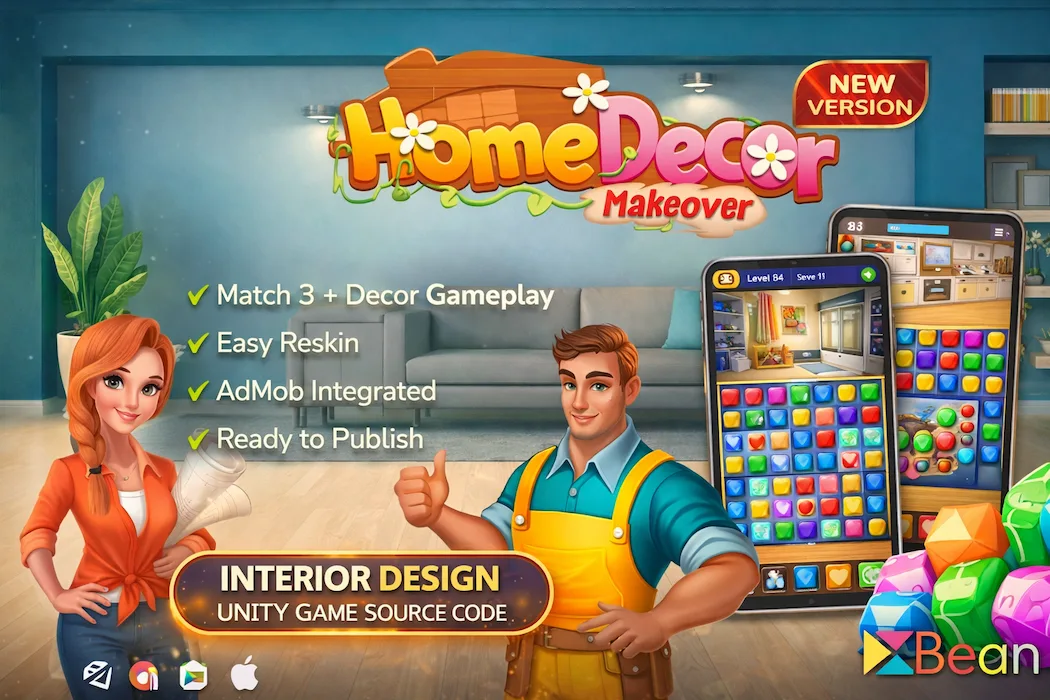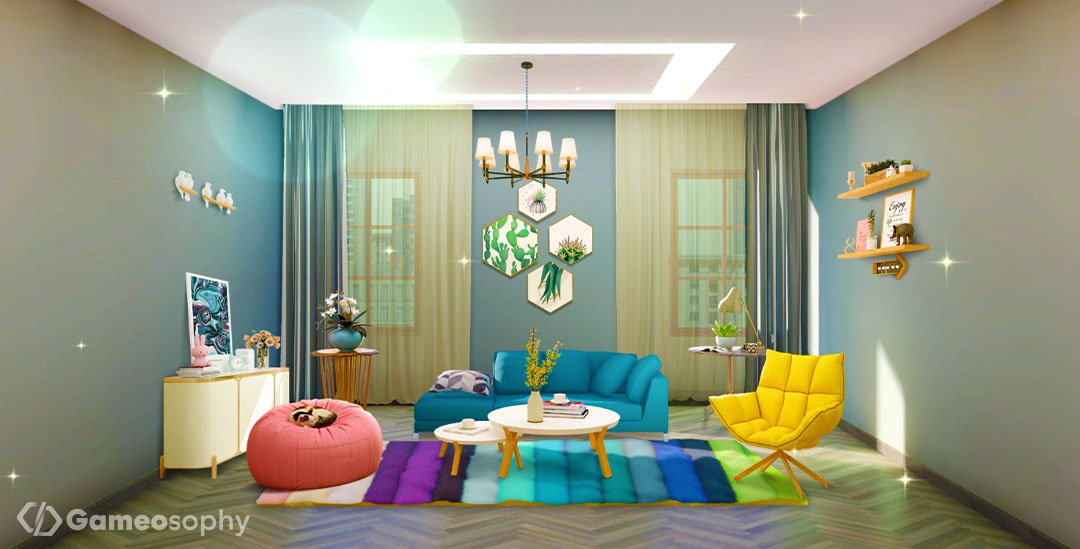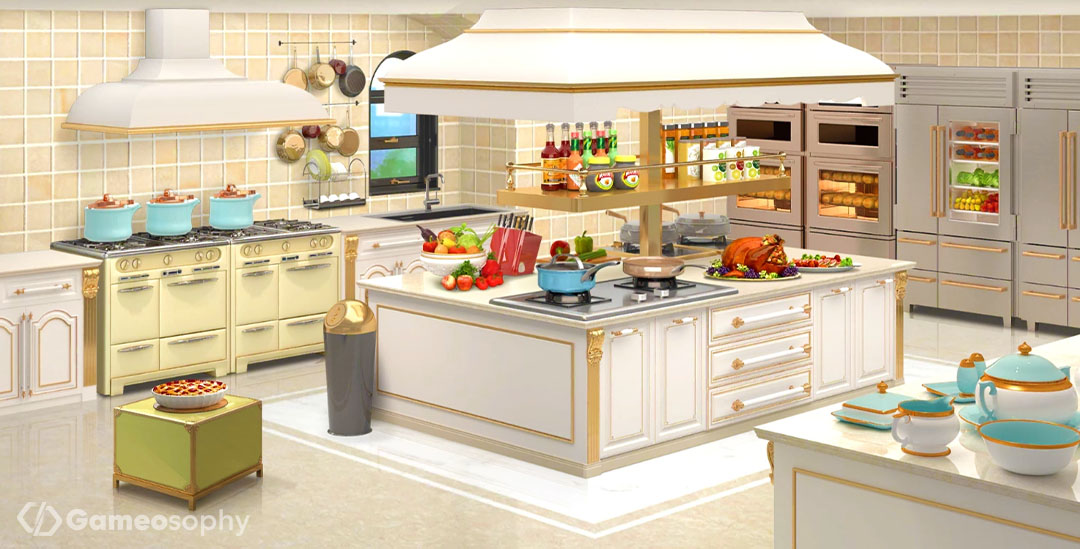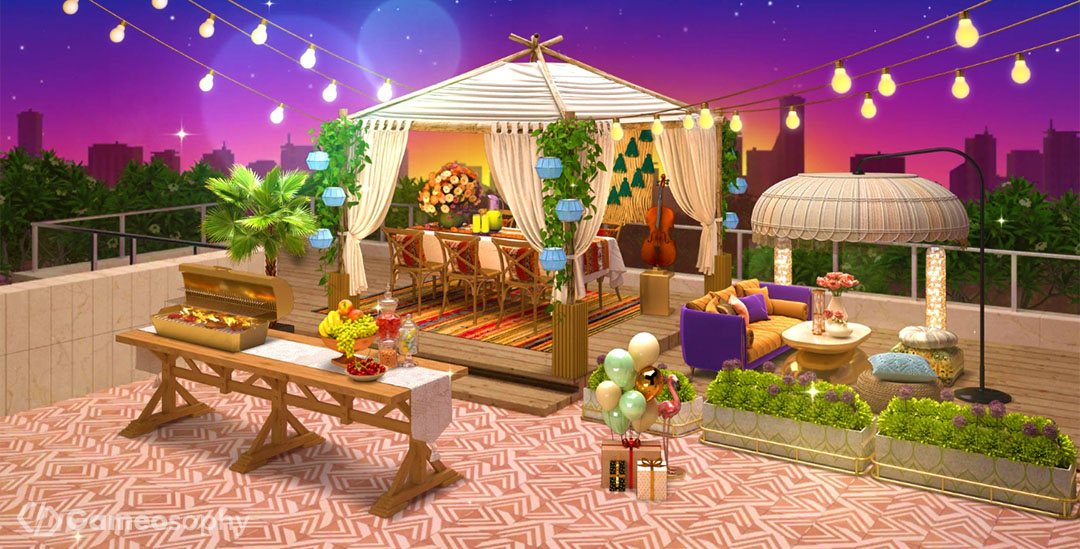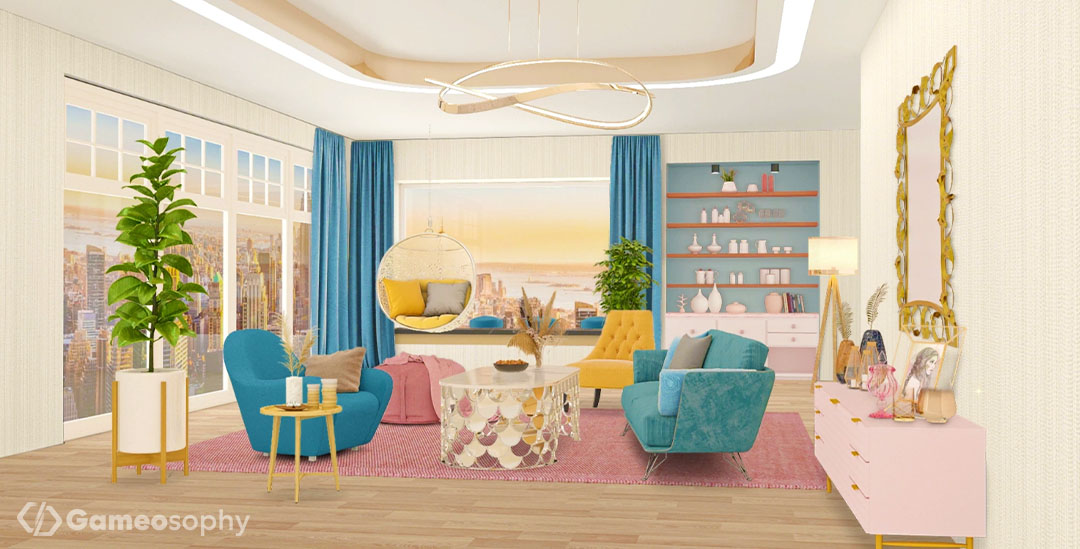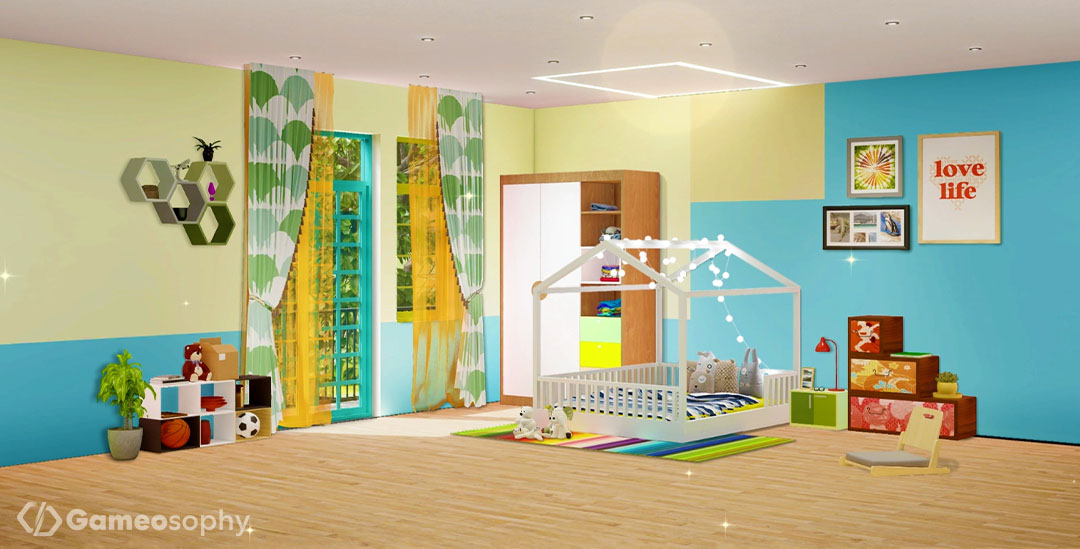

Home Design Makeover is a complete Unity game source code package built around one of mobile gaming's most consistently profitable genres — interior design and room renovation. Players step into the shoes of an interior designer, transforming neglected spaces into polished, modern living areas by making creative décor decisions across multiple rooms and levels.
This is not a stripped-down prototype or a concept demo. It is a fully playable, mobile-optimized Unity game template with a structured progression loop, multi-room renovation stages, a working reward system, and a monetization-ready architecture that supports both AdMob ad integration and in-app purchases. Whether you want to publish it as a standalone game after reskinning or use it as a foundation to build a larger design title, the source code gives you a strong, professionally structured starting point.
Interior design games consistently rank among the top-earning casual titles on Google Play and the Apple App Store. The player demographic — predominantly women aged 25–45 — is one of the most valuable segments in mobile advertising, with eCPMs frequently running 30–50% higher than hyper-casual averages. This template puts that revenue opportunity directly within reach.
Each level presents the player with a room in its undecorated state. The gameplay follows a satisfying before-and-after structure:
The player receives a renovation brief — a living room, bedroom, kitchen, or outdoor space — and works through it by selecting furniture pieces, color palettes, and decorative accessories from a curated catalogue. Every decision changes what appears on screen in real time, letting players see the impact of each choice immediately. Completing a room earns stars and unlocks the next challenge.
This loop is deliberately simple on the surface but layered in engagement mechanics. Players are not just decorating — they are making trade-off decisions between design options, balancing aesthetics with the reward structure, and building toward unlocking premium room themes. That cognitive engagement is exactly what drives the high day-7 and day-30 retention figures the genre is known for.
Progression is tied directly to creative output. Finishing a room design awards in-game currency and star ratings based on the quality of choices made. Stars accumulate to unlock new room categories, premium décor sets, and story-driven renovation scenarios.
The reward architecture is built to accommodate both free-to-play ad monetization and optional IAP without requiring a rebuild of the progression system. Players can earn currency organically through gameplay, watch rewarded ads to accelerate progress, or make small purchases to unlock premium furniture collections — all three paths coexist cleanly in the existing code.
Home design and room makeover games are not a trend — they are a durable category. Titles in this space generate strong lifetime value per user because they attract players who return daily, engage with light narrative, and spend on cosmetic content. The combination of high eCPM ad revenue and a player base willing to make small IAP purchases creates a monetization ceiling that purely hyper-casual games rarely reach.
The Home Design Makeover template is structured specifically to support this revenue model. The ad placements are positioned at natural moments — between rooms, after a design reveal, when the player wants to speed up an unlock — rather than interrupting active gameplay. That placement strategy keeps completion rates high and CPM values competitive.
Retention is the metric that determines long-term revenue, and retention in casual games comes from two things: clear daily goals and visible progress. This template delivers both. Every session has a defined task (finish this room), a visible payoff (the before-and-after reveal), and a clear next goal (unlock that room theme). That loop keeps players coming back without requiring complex live-ops infrastructure.
If you are a Unity developer looking to enter the casual gaming market without spending months on custom systems, this template eliminates the most time-consuming work. The core gameplay loop, the progression architecture, the monetization framework, and the mobile optimization are all done. What remains is the creative and marketing work — reskinning the visual identity, writing store descriptions, setting up your AdMob account, and submitting to the stores.
For a deeper breakdown of how ready-made templates compress the path from idea to published game, read: Why Ready-Made Unity Source Code Can Speed Up Game Development in 2026
| Package Contents | Included |
|---|---|
| Complete Unity Project (all scenes, scripts, prefabs, assets) | ✅ Yes |
| Compiled Android APK for device testing | ✅ Yes |
| PNG image assets for UI and gameplay elements | ✅ Yes |
| Documentation (project setup, AdMob config, build guide) | ✅ Yes |
| AdMob integration (rewarded, interstitial, banner) | ✅ Yes |
| IAP framework (coin packs, premium unlocks) | ✅ Yes |
| GUI Kit (additional UI components) | ✅ Free |
Replacing the visual style is the single most important step before publishing. The asset structure is organized so that all furniture sprites, room backgrounds, UI icons, and color themes are stored in clearly named folders. Swapping them requires no code changes — only asset replacement through the Unity editor.
A typical reskin for this template involves replacing the furniture catalogue visuals, updating the room background images, redesigning the app icon and splash screen, and selecting a new color palette for the UI. Most developers with basic Unity familiarity complete this in three to five days.
If you would prefer to have the reskinning handled professionally, the reskinning service is available directly on the platform.
The modular architecture makes adding new rooms, furniture sets, and theme categories straightforward. Each room is a self-contained scene with a defined item slot structure — adding a new room means duplicating the scene, populating it with new assets and a design brief, and adding it to the progression sequence. No changes to core systems are required.
Common content extensions developers add before publishing include seasonal decoration themes (holiday rooms, outdoor garden spaces), a premium furniture catalogue unlockable through IAP, and a photo-sharing feature that lets players screenshot their finished rooms.
Both AdMob and IAP are pre-integrated with placeholder IDs. Activating them for live revenue requires replacing the test ad unit IDs with your own AdMob publisher IDs and configuring your Google Play or App Store IAP product catalogue to match the purchase structures already defined in the project. This is a configuration task, not a development task, and the included documentation walks through it step by step.
AdMob Ads (pre-integrated) Rewarded video ads between room reveals, interstitial ads between levels, and banner ads on the main menu and currency screens. All ad unit slots are pre-configured; only your publisher IDs need to be inserted.
In-App Purchases (framework included) Coin packs for accelerating progress, premium room unlock bundles, and decorative collection sets. The IAP structure mirrors what top-performing home design titles on the App Store use.
Reskin and Publish Service If you want to go from purchase to published app without handling the customization yourself, the platform offers a full reskin and publish service that covers visual replacement, store listing creation, and submission.
Looking for more casual and simulation game templates to expand your portfolio or compare options? These titles pair well with the Home Design Makeover template:
A complete cooking simulation game targeting the same casual demographic. Strong narrative loop, daily challenge system, and hybrid ad + IAP monetization make it a natural companion title for players who love Home Design Makeover.
An idle tycoon simulation with offline earnings, upgrade trees, and AdMob integration. Targets an overlapping audience of casual players who enjoy progression-based gameplay. Excellent for building a cross-promotion portfolio alongside a design game.
A harvest and cooking simulation that combines two of casual gaming's strongest genres. The progression model and visual style appeal to the same player base as interior design games.
For developers who want to diversify beyond simulation into action, this crowd runner template is one of the platform's highest-rated products. Strong monetization profile and viral gameplay loop.
Browse the full Unity game source code collection to explore all available templates.
Understanding the casual game market before you publish gives you a significant advantage in store optimization, pricing, and ad strategy. These guides are worth reading alongside your purchase:
Why Ready-Made Unity Source Code Can Speed Up Game Development in 2026 Explains exactly how template-based development compresses the timeline from idea to live game, with specific examples of which systems take the longest to build from scratch and why starting with a complete project changes the math.
How to Make Money with Unity Games Using AdMob (Step-by-Step Guide) A practical breakdown of AdMob placement strategy, eCPM benchmarks by genre, rewarded vs interstitial ad behavior, and how to structure your first monetized game release to earn from day one.
Home Design Makeover is one of the most complete casual game templates available for Unity developers targeting the lucrative home and design genre. The core systems are built, the monetization is wired in, and the progression loop is proven. What you bring is the visual identity and the ambition to publish.
Regular License — $79 (down from $199): Single app, free-to-play, AdMob monetization Extended License — $399: Paid apps, client delivery, commercial resale
[Add to Cart] [Buy Now]
Have questions before purchasing? Contact the team on WhatsApp or review the FAQs for detailed answers about licensing, support, and what's included.
You need to login to comment!
Total Sold:
0
Total Comments: