Every Unity developer eventually hits the same fork in the road. You have a game idea, a deadline you set for yourself, and two very different paths in front of you: write every line of code from a blank project, or start with a working Unity source code template and build on top of it. I have shipped projects both ways, watched clients burn three months on a prototype that a ready-made template could have delivered in three days, and also watched teams cut corners on a template-based build and pay for it later in App Store rejections. Neither path is automatically right. This guide breaks down exactly when each approach wins, backed by real numbers, a short case study, and the questions developers ask me most often.
By the end of this article you will know which route fits your budget, your timeline, and your skill level, and you will have a clear decision framework instead of a gut feeling.
Unity source code refers to a complete, working game project built in Unity that includes the C# scripts, scenes, prefabs, UI, and often monetization integrations like AdMob already wired in. It is different from a single asset pack or a Unity Asset Store plugin. A proper source code package is a finished, playable game that a developer can rebrand, reskin, or extend. Think of it less like a Lego brick and more like a fully assembled Lego set that you are free to repaint and rearrange.
A good example is a puzzle template such as the Snake Escape Puzzle Unity Game, which ships with maze logic, swipe controls, level progression, and ad placements already built and tested. A developer buying this is not starting with an empty Unity scene; they are starting from a functioning product and deciding how to make it their own.
Building from scratch means opening a blank Unity project and writing every system yourself: player input, game logic, UI navigation, save systems, ad SDK integration, performance optimization, and bug fixing, all before a single playable build exists. There is no shortcut here. Every mechanic, no matter how small, has to be designed, coded, tested, and refined.
This path gives total creative and technical control. It also means the first two to four weeks of a project are usually invisible to anyone outside the development team, because there is nothing to show except code and broken prototypes.
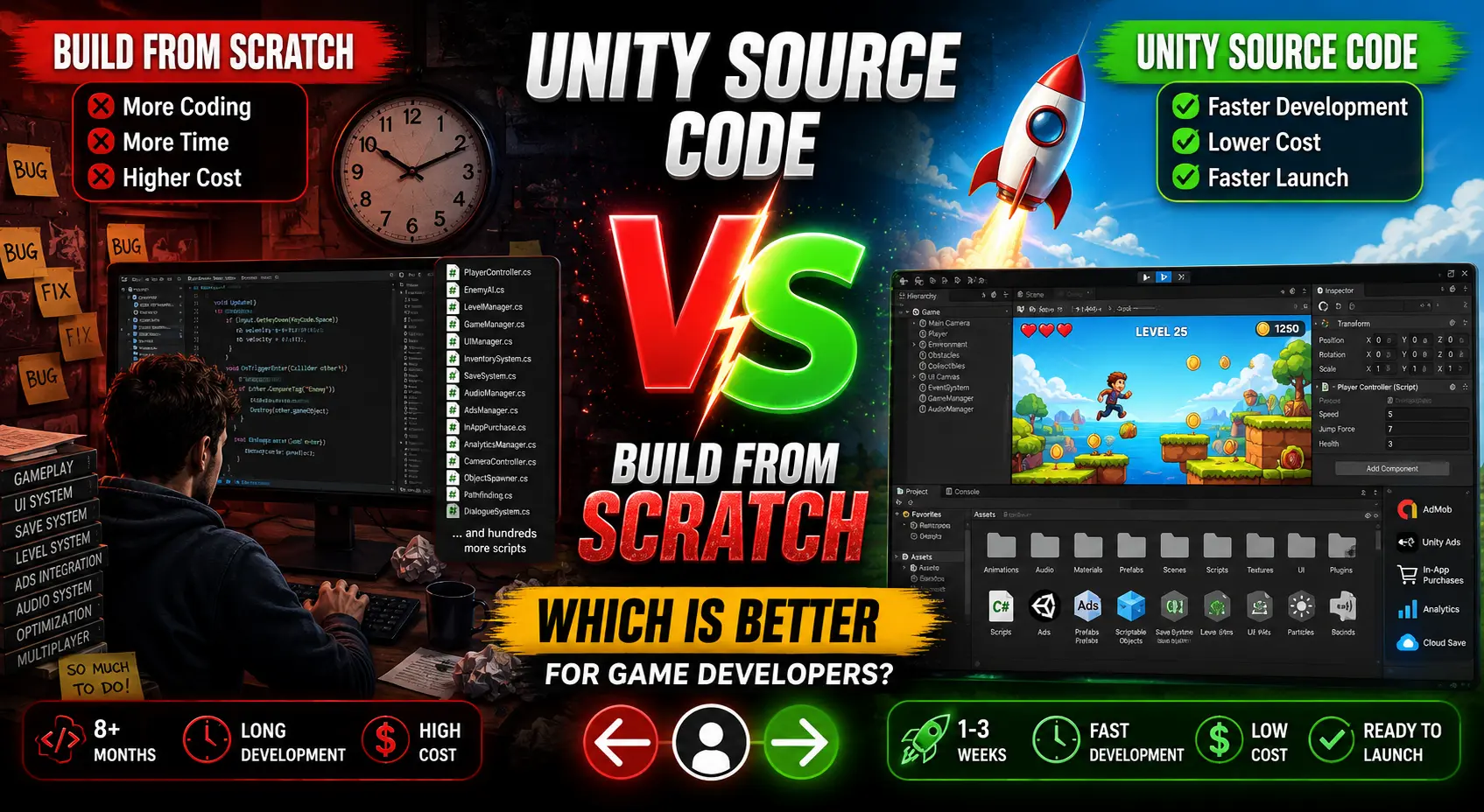
Here is how the two approaches actually compare across the factors that matter most to working developers, not just in theory but based on typical project outcomes.
| Factor | Unity Source Code vs From Scratch |
| Development Time | Source code: 3–10 days to a customized build. Scratch: 6–12+ weeks for the same scope. |
| Upfront Cost | Source code: $29–$499 typical range. Scratch: developer salary or freelance cost over months. |
| Code Quality Control | Source code: depends on the seller; reputable sources are pre-tested. Scratch: fully in your control. |
| Learning Value | Source code: learn by reading working code. Scratch: deeper learning, slower progress. |
| Customization Limits | Source code: bound by original architecture. Scratch: unlimited, but time-expensive. |
| Risk of Failure | Source code: lower, proven gameplay loop. Scratch: higher, unproven mechanics. |
| Best For | Source code: solo devs, agencies, fast launches. Scratch: unique IP, long-term flagship titles. |
“The fastest way to ship a bad decision is to spend three months coding a mechanic you could have tested in three days with a template.” — A lesson most Unity developers learn the expensive way, once.
There are specific situations where buying ready-made source code is not a shortcut but the genuinely smarter business decision.
If you want to know whether a hyper-casual puzzle concept will retain players before investing real development time, a template like Idle Market Tycoon Unity Source Code lets you reskin, publish, and measure real retention and ad revenue data within a week instead of guessing for a quarter.
Client work often comes with launch dates that were agreed before development even started. Starting from a tested codebase means you spend your hours on customization and client-specific features rather than rebuilding basic mechanics that already exist in dozens of working templates.
Multiplayer architecture is one of the most time-consuming systems to build correctly. A project such as Ludo Online Multiplayer Game already solves matchmaking, real-time sync, and turn logic, problems that can otherwise take an experienced developer four to six weeks to stabilize.
Reading well-structured, production-grade code teaches patterns that tutorials rarely cover, such as object pooling, save-state management, and clean separation between UI and game logic. Many developers learn faster by modifying a working project than by following another beginner course.
Source code is not always the right answer. There are scenarios where starting from zero protects your business in ways a template cannot.
If your core gameplay loop has never been built before, no template exists for it. Forcing an original idea into someone else's architecture usually creates more rework than starting clean.
Games meant to run for years, scale to millions of users, and support live-ops content need an architecture designed around your specific roadmap. A template optimized for a quick reskin is rarely built to handle five years of feature additions cleanly.
Publicly traded studios, investors, or publishers sometimes require proof that 100% of the codebase was developed in-house. In these cases, the legal clarity of from-scratch development outweighs the time savings of a template.
If you already have Unity developers on payroll with no other tasks, the marginal cost of building from scratch is lower because you are not paying extra for the time, you are simply using time you have already budgeted for.
A solo Unity developer I worked with in 2025 started building an idle tycoon game completely from scratch. After five weeks, he had a basic clicker loop, no save system, no monetization, and no UI polish. He was burned out and behind his self-imposed launch date by over a month.
He switched strategy and purchased a finished idle template similar to Idle Market Tycoon Unity Source Code, spent four days reskinning the art, swapping in his own theme and currency names, and connecting his own AdMob account. He published the game ten days after the switch, three and a half weeks faster than his original from-scratch estimate.
The lesson was not that from-scratch development is bad. It is that he spent his limited solo-developer time rebuilding systems, like save persistence and ad mediation, that had already been solved and tested hundreds of times before. Buying that solved problem let him spend his remaining time on the one thing a template could not give him: his own creative theme and brand.
Key takeaway: the smartest developers do not choose source code OR scratch development as an identity. They choose whichever path gets a tested, monetizable game in front of real players fastest, and save scratch development for the ideas that truly need it.
In practice, most profitable mobile game studios use a hybrid model. They license or buy proven source code for core systems that are not their competitive advantage, things like UI frameworks, ad mediation, and save systems, while building their unique gameplay hooks and art direction entirely custom. This gives them speed where speed does not hurt the product, and originality exactly where originality matters to players.
If you found this comparison useful, these resources go deeper into specific parts of the Unity development process:
You can also browse our full Games category to compare ready-made templates directly, or look at specific projects such as the Snake Escape Puzzle Unity Game, the Ludo Online Multiplayer Game, and the Idle Market Tycoon Unity Source Code to see what a production-ready Unity template actually includes before you decide which path fits your next project.
Neither approach is universally better. Unity source code wins on speed, cost predictability, and lower risk, making it the right call for testing ideas, hitting tight deadlines, and learning by example. Building from scratch wins on full ownership, unlimited customization, and long-term scalability, making it the right call for original mechanics and flagship products with years of planned growth ahead of them.
The developers who consistently ship successful games are not the ones who pick a side. They are the ones who match the approach to the project, use source code to move fast when speed matters, and reserve from-scratch development for the moments when originality and ownership are worth the extra months.
No. Buying Unity source code is a standard, accepted practice across the mobile game industry, similar to using a website template instead of coding HTML from zero. What matters legally and ethically is that you have a proper license to reskin and publish the project, which reputable marketplaces provide clearly with each purchase.
Yes, as long as the final build is sufficiently reskinned, functionally distinct, and complies with each store's content and metadata policies. Submitting a template completely unmodified, with the original branding intact, is the main reason these submissions get rejected, not the use of source code itself.
Building a simple hyper-casual game from scratch with a freelance developer typically costs between $1,500 and $6,000 depending on complexity and region, and takes six to twelve weeks. A comparable Unity source code template usually costs between $29 and $499, with customization taking three to ten days. The cost gap is large precisely because most of the freelancer's time goes into rebuilding systems that templates already include.
It depends on how you use it. Treating source code as a black box you never open will limit your learning. Treating it as a study resource, reading the scripts, understanding why each system is structured the way it is, and modifying it deliberately, often accelerates learning faster than building everything from zero, because you are studying patterns that already work in production.
Yes, and this is exactly what the hybrid approach described earlier in this guide recommends. Many developers start with a base template such as the Idle Market Tycoon Unity Source Code, then add their own custom progression systems, art, or monetization logic on top of the existing foundation.
The biggest risk is sinking months of development time into a mechanic or system before knowing whether players actually want it. Unproven mechanics built entirely from scratch carry a higher chance of wasted effort compared to validating the same idea quickly with an existing template first.



