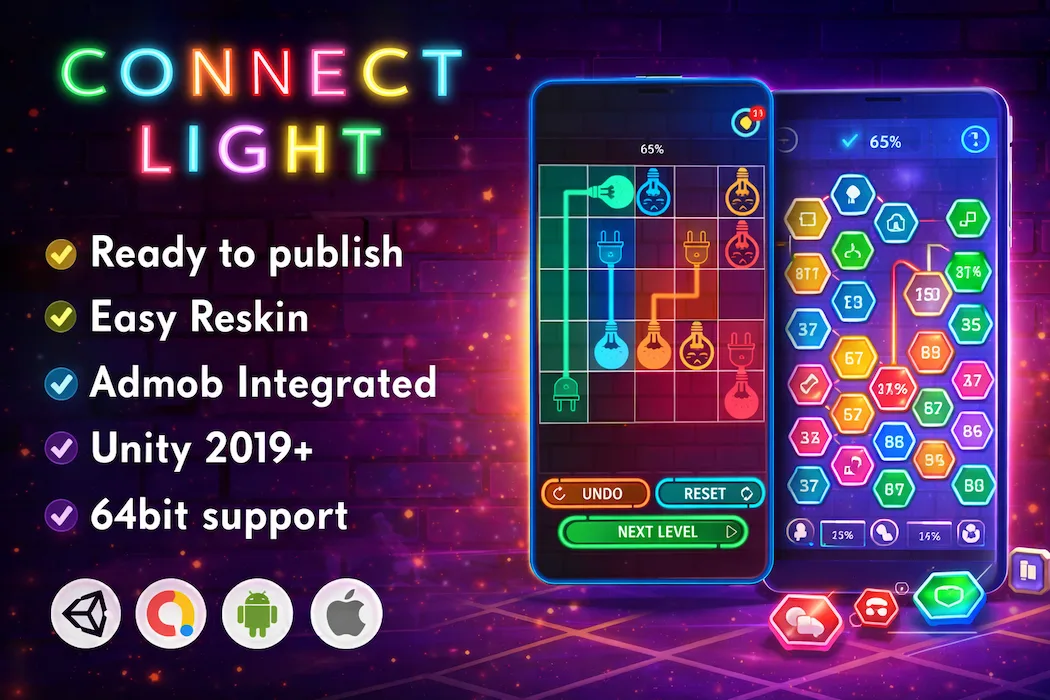

Think about the last time you flipped a light switch and nothing happened. That small flicker of "wait, why isn't this working" is oddly compelling — and it's the exact feeling Connect Light Puzzle turns into a full gameplay loop. Instead of frustration, players get the satisfaction of tracing the right path and watching every light on the board switch on at once.
It's a deceptively simple idea for a Unity template, and that simplicity is exactly why it works so well as a foundation for a mobile puzzle release.
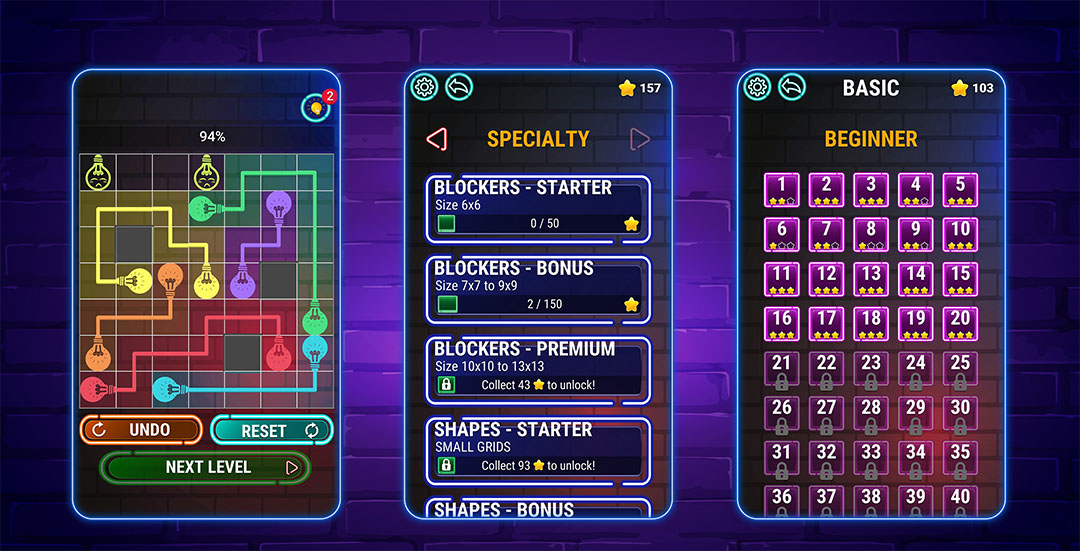
At its core, this is a connection puzzle. Players trace lines, wires, or paths across a board until every element lights up, completing the circuit. There's no combat, no timer pressure in the early levels, and no steep onboarding — just a board, a goal, and a logical path to get there.
That accessibility is the whole appeal. A five-year-old and a fifty-year-old can both understand "connect the dots to make the lights turn on" within seconds of looking at the screen.
Later levels complicate this in small, deliberate ways — crossing paths, limited connection points, or multiple circuits that need to be completed in the right order. None of it requires new rules to learn, just sharper thinking about the rules you already know.
Connection puzzles occupy a strange, valuable middle ground in mobile gaming. They're calm enough to feel relaxing, but structured enough to genuinely exercise logical thinking. That combination is rare — most casual genres lean hard into one side or the other.
For comparison, something like Pop It 3D leans almost entirely into sensory satisfaction with very little cognitive demand — it's built for pure stress relief, not problem-solving. Connect Light Puzzle sits a notch further up the thinking scale while still keeping the same low-pressure, no-fail-state feel that makes fidget-style games so approachable.
It's also worth separating this from puzzle games built around physical object manipulation rather than pure logic. A title like Pull the Pin: Girl Adventure asks players to reason about physics and object placement — pins, gravity, chain reactions. Connect Light Puzzle is closer to pure abstract logic, more akin to solving a small circuit diagram than predicting how objects will fall. Both are puzzle genres, but they exercise completely different parts of a player's brain, which matters if you're deciding which style fits your audience.
If you want something even closer in spirit — pure logic, minimal theming, straightforward rules — it's worth looking at how Puzzle Box approaches a similarly abstract challenge. Studying a few logic-first titles side by side is often the fastest way to figure out what makes one connection puzzle feel fresh and another feel like a retread.
The interface stays out of the player's way on purpose. Bright, clear visual feedback shows exactly which paths are active and which lights still need connecting, with smooth animations that make each successful connection feel immediately rewarding. There's no clutter competing for attention — just the board, the paths, and the goal.
Nothing here requires deep technical knowledge to get running — it's built to be opened, understood, and modified without a steep learning curve.
Puzzle games with this kind of level-based structure are naturally suited to ad monetization. Level completions create clean break points for interstitial ads, while rewarded video slots fit comfortably into hint systems or bonus content. Because sessions tend to run long and repeat often — logic puzzles are famously "just one more level" games — ad performance tends to hold up well over time.
There's also room for light in-app purchases, whether that's cosmetic board themes or optional convenience features, without disrupting the core experience. If you're weighing different monetization paths for a puzzle release like this, how to make money with Unity games walks through the broader landscape of ad models, IAP structures, and hybrid approaches worth considering before you lock in a strategy.
Because the visual layer is separated from the underlying puzzle logic, the entire theme can be swapped — different color palettes, board styles, or even a complete departure from the "electrical circuit" concept toward something like water pipes, glowing crystals, or magical runes. The mechanic underneath stays exactly the same; only the skin changes.
This is a similar philosophy to how simulation-style titles get reworked across different settings. A cooking sim like Pizza Maker and a trade-focused title like Plumber Ultimate both prove that a strong core loop can support wildly different surface themes without needing new mechanics underneath — the same reskinning logic applies directly here.
It's a particularly good fit for anyone newer to Unity development, since the codebase is compact enough to fully understand without getting lost in overly complex systems.
If connection puzzles aren't quite the right fit, or you're weighing this against other genres before committing, it's worth browsing the full games category to compare mechanics, art styles, and monetization approaches across the marketplace before settling on your next build.
Connect Light Puzzle takes one of the simplest ideas in puzzle design — trace a path, complete a circuit — and turns it into a clean, ready-to-publish Unity template. It's approachable enough for absolute beginners to build with, flexible enough to reskin into almost anything, and structured in a way that makes monetization straightforward rather than an afterthought. For a first puzzle release or a fast addition to an existing portfolio, it's a practical, low-risk starting point.
Do players need any tutorial to understand the gameplay? No. The core mechanic — connecting paths to light up elements — is visually intuitive and typically understood within the first few seconds of play, with no lengthy tutorial required.
What Unity version does this template require? It's built on Unity 2019.3.15f1, requiring the free Unity license version 2019 or later. Building for iOS also requires macOS and Xcode.
Can I completely change the visual theme without breaking the mechanic? Yes. The puzzle logic and visual assets are separated, so you can reskin the board, paths, and lighting effects into a different theme without touching the core gameplay code.
Is this template suitable for someone new to Unity development? Yes, it's a good fit for beginners since the codebase is compact and organized, making it easier to study and modify compared to more complex genres.
How is monetization typically handled for this type of puzzle game? Common approaches include interstitial ads between levels, rewarded ads for hints, and optional in-app purchases for cosmetic themes or convenience features.
Can I add more levels or increase difficulty after launch? Yes, the level structure is designed to be expanded, so adding new boards or increasing complexity doesn't require reworking the underlying systems.
Is this a good template for a first mobile game release? It's a reasonable choice for a first release given its low complexity, quick reskin potential, and straightforward monetization structure, though results will still depend on execution and marketing.
Does the purchase include documentation and support? Yes, documentation is included, and support is available depending on the license tier chosen at checkout.
You need to login to comment!
Total Sold:
0
Total Comments: