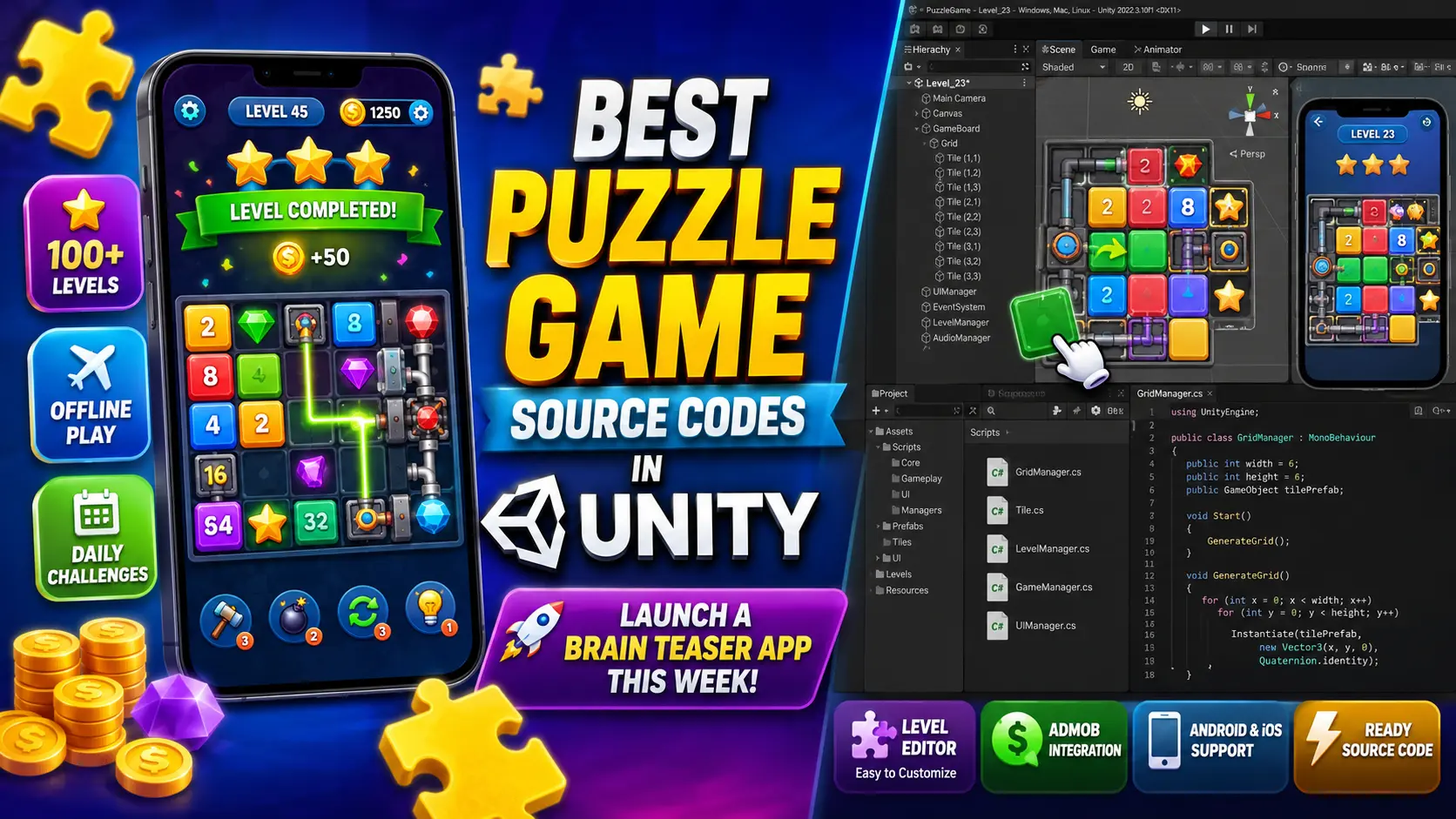
Puzzle games remain one of the most downloaded and most profitable categories on both the App Store and Google Play. From match-3 classics to merge mechanics and physics-based brain teasers, players can't get enough of quick, addictive gameplay loops. If you're a developer, indie studio, or entrepreneur looking to enter the mobile gaming market fast, buying a puzzle game source code in Unity is the smartest shortcut available today.
Instead of spending months building a game engine, UI system, and monetization logic from scratch, you can grab a ready-made Unity puzzle game template, rebrand it, plug in your ads and IAPs, and publish a fully working brain teaser app in as little as a week. In this guide, we'll walk through why puzzle games are booming, what to look for in quality source code, the best puzzle game categories to invest in, and a realistic week-by-week plan to take your app from purchase to publish.
Puzzle games have consistently ranked among the top-grossing categories on mobile app stores for over a decade, and that trend shows no sign of slowing down. Here's why this genre continues to dominate:
For solo developers and small studios, this combination of low complexity and high earning potential makes puzzle games one of the safest genres to launch a new brand or test a new publishing pipeline.
A Unity puzzle game source code is a complete, functional project built in the Unity engine that already includes core gameplay mechanics, UI screens, level progression systems, and often basic monetization hooks. Instead of coding a match-3 grid system or a merge-mechanic inventory from zero, you receive a working project that you can:
This approach is commonly called "buying ready-made source code" and is a popular alternative to using free Unity Asset Store templates, which often require significant additional coding work. If you're deciding between the two routes, our detailed comparison on Unity Asset Store vs ready-made source code breaks down the pros, cons, and cost differences of each option.
Not all puzzle mechanics perform the same. Below are the top-performing puzzle sub-genres worth investing in right now, based on current app store trends and player engagement data.
The evergreen genre. Match-3 mechanics are easy to reskin into candy themes, farm themes, or seasonal events, and they pair extremely well with meta-layers like story progression or base building.
Merge mechanics have exploded in popularity over the last few years because they combine puzzle-solving with idle progression, keeping session times longer and retention higher. If you want a proven merge mechanic ready to reskin, check out the Merge Room Unity game source code — a complete merge-puzzle project with polished UI and progression systems already built in.
Crosswords, word search, sudoku, and number-sorting games have a loyal, older demographic that spends more time in-app and responds well to subscription-based monetization models.
Games involving gravity, ropes, pins, and block-sliding mechanics are highly shareable on social media because of their satisfying "aha" moments, making them great for organic virality.
Water sort, ball sort, and block puzzle games are extremely lightweight to build, run smoothly even on low-end devices, and are among the fastest games to reskin and relaunch.
If you want to explore a wide range of ready-to-launch puzzle mechanics and other genres side by side, browse our full Unity game source code products page or explore the dedicated games category for curated options across match-3, merge, runner, and simulation genres.
Building a puzzle game from the ground up typically requires:
That's easily 6–12 weeks of development time and a significant budget before you even have a testable build. By contrast, ready-made source code compresses this timeline dramatically because the hardest parts — core mechanics, game logic, and UI architecture — are already done and tested.
This doesn't mean it's a copy-paste job. A good source code purchase still requires reskinning, content updates, and monetization setup, but the heavy lifting of engineering is already handled. This is precisely why more solo developers and small studios are turning to ready-made projects instead of hiring full development teams or relying solely on free store assets.
Here's a realistic, achievable roadmap for taking a purchased puzzle game source code from download to store submission in seven days.
Pick a puzzle mechanic that fits your target audience and budget. Consider factors like file size, supported Unity version, included documentation, and whether ad/IAP SDKs are pre-integrated. Browsing the full products catalog lets you compare options across genres before committing.
Install the correct Unity Editor version specified in the source code documentation, import the project, and do a test build to confirm everything compiles and runs correctly on both Android and iOS (if applicable).
This is where your brand comes to life. Replace placeholder art, update color palettes, change fonts, rename the app, and swap icons and splash screens. If you're new to this process, our step-by-step guide on how to reskin a Unity game template walks through exactly which files and assets to modify for a clean, professional rebrand.
Boost retention by adding or configuring leaderboards, achievements, and daily reward systems. These features significantly increase session frequency and time-in-app, which improves your ad revenue and store ranking. Our guide on how to add leaderboards and achievements covers integration with Google Play Games Services and Apple Game Center step by step.
Decide on your monetization mix — ad-only, IAP-only, or a hybrid model. Most successful puzzle games use a blend of rewarded ads, interstitials, and small IAP bundles for boosters or ad removal. If you're unsure which model fits your app best, read our breakdown of in-app purchases vs ad revenue for Unity games to understand which strategy maximizes revenue for casual puzzle titles specifically.
Run a final QA pass across multiple device sizes, check for crashes, verify ad placements aren't intrusive, and confirm purchase flows work correctly in sandbox mode. Once everything checks out, generate your signed build and submit it to the Google Play Console and/or App Store Connect.
Following this timeline, it's entirely realistic to go from an unopened source code folder to a live app listing within seven focused days — especially if you're not building mechanics from scratch.
Not every source code listing is created equal. Before purchasing, check for the following:
While this guide focuses on puzzle and brain teaser apps, many successful publishers don't stop at a single genre. Running multiple game types under one developer account helps spread risk and capture different audience segments. For instance, action and combat-style games like the Last War survival battle crowd runner combat source code appeal to a completely different demographic than casual puzzle players, giving you a broader portfolio and more diversified ad revenue streams.
If you're building a long-term publishing business rather than a single app, it's worth exploring the full range of available genres on the homepage to see which combinations of casual, puzzle, and action titles might work well together in your portfolio.
Launching a brain teaser app doesn't have to take months of development and thousands of dollars in engineering costs. With the right Unity puzzle game source code, a clear reskinning plan, and a solid monetization strategy, you can realistically take a project from purchase to published app store listing in about a week. Whether you choose a match-3 classic, a merge mechanic, or a physics-based brain teaser, the key is starting with a clean, well-built foundation and focusing your time on branding, content, and monetization rather than reinventing core gameplay systems.
If you're ready to get started, explore our full collection of Unity game source codes and find the puzzle mechanic that fits your next launch.
Q1: What is the fastest way to launch a puzzle game on Unity? The fastest method is to purchase a ready-made Unity puzzle game source code, reskin it with your own branding, integrate monetization, and submit it to the app stores. This approach can take as little as a week, compared to months of development from scratch.
Q2: Is it legal to buy and resell a Unity game source code as my own app? Yes, as long as the source code is sold with a commercial license that permits reskinning and publishing. Always confirm the license terms with the seller before purchase to ensure you have full rights to modify, rebrand, and publish the game under your own developer account.
Q3: Do I need coding experience to use a Unity puzzle game source code? Basic familiarity with the Unity Editor is helpful, especially for reskinning assets, adjusting level data, and configuring SDKs. However, most ready-made source codes are designed to minimize the need for deep programming knowledge, since core mechanics are already built and documented.
Q4: How much does it cost to buy a puzzle game source code for Unity? Prices vary widely depending on the complexity of the mechanics, quality of the art, and included features like ad integration or leaderboard systems. It's significantly cheaper than hiring a development team to build the same game from scratch.
Q5: Which monetization model works best for puzzle and brain teaser apps? A hybrid model combining rewarded video ads, interstitial ads, and small in-app purchases for boosters or extra lives typically performs best for casual puzzle games. The right mix depends on your audience and retention rates, which is covered in more detail in our guide on in-app purchases versus ad revenue.
Q6: Can I customize the levels and difficulty in a purchased puzzle game template? Yes. Quality puzzle game source codes are built with scalable level systems, allowing you to add, remove, or rebalance levels without altering the core codebase.
Q7: What's the difference between free Unity Asset Store templates and paid ready-made source code? Free Asset Store templates often require substantial additional coding, lack complete UI systems, and may not include monetization integration. Paid ready-made source code is typically more complete, tested, and ready for faster reskinning and publishing.
Q8: How do I add leaderboards and achievements to a puzzle game? You'll need to integrate Google Play Games Services for Android and Apple Game Center for iOS, then hook these services into your game's scoring and progression systems. A full walkthrough is available in our leaderboards and achievements integration guide.
Q9: What Unity version should I use for a puzzle game source code? Always check the documentation included with your purchased source code for the recommended Unity Editor version, and use the closest matching LTS (Long Term Support) release to avoid compatibility issues.
Q10: Can one developer manage multiple puzzle game apps at once? Yes, many solo developers and small studios run several reskinned puzzle titles simultaneously, using the same core source code with different themes and branding to diversify their app portfolio and revenue streams.



