

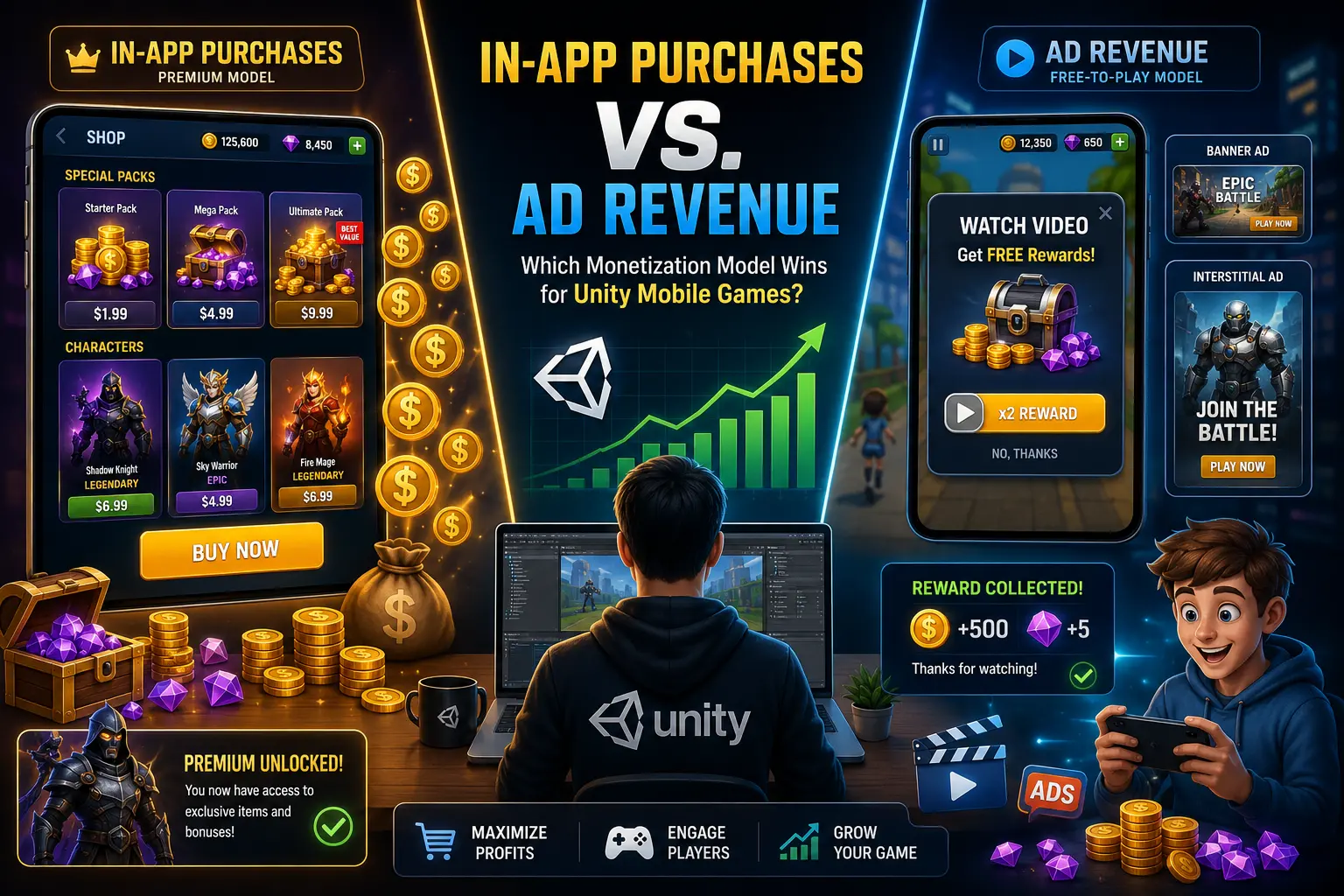
If you're building a Unity mobile game, one question eventually stops every developer in their tracks: how do I actually make money from this? You've spent weeks (or months) polishing mechanics, fixing bugs, and getting the build ready for the App Store and Google Play — but a great game with the wrong monetization strategy can still fail commercially.
The two dominant monetization models in mobile gaming today are In-App Purchases (IAP) and Ad Revenue (rewarded ads, interstitials, banners, and offerwalls). Some studios lean entirely on one model, others blend both into a hybrid approach, and the "right" answer depends heavily on your genre, audience, retention numbers, and long-term goals.
In this guide, we'll break down how both models work, their pros and cons, real-world benchmarks, and how to decide which monetization strategy fits your Unity game — whether you're shipping an original title or working from a ready-made Unity game template.
Mobile gaming is a saturated market. With over 5 million apps competing for attention across app stores, simply launching a game isn't enough — you need a monetization model that matches player behavior in your specific genre. A hyper-casual puzzle game and a mid-core RPG have completely different player psychology, session lengths, and spending habits, which means a one-size-fits-all monetization approach almost never works.
Unity remains the engine of choice for mobile game development because of its flexibility, asset ecosystem, and native support for ad mediation SDKs (Unity Ads, AdMob, IronSource/Unity LevelPlay, AppLovin MAX) and IAP frameworks (Unity IAP, RevenueCat). Choosing between IAP and ad revenue — or combining them — starts with understanding what each model actually offers.
In-App Purchases let players spend real money directly inside your game to unlock content, currency, cosmetics, or convenience. Common IAP categories in Unity mobile games include:
IAP works best in games with depth — where players form emotional investment, build progress, or chase competitive advantages. Think match-3 games with power-ups, city builders with premium currency, or puzzle games with hint systems.
Ad-based monetization earns money by showing advertisements to players — regardless of whether they ever spend a dollar. This is the dominant model in hyper-casual and casual games, where session times are short and player retention curves drop quickly.
Common ad formats in Unity mobile games:
| Factor | In-App Purchases | Ad Revenue |
|---|---|---|
| Best genre fit | Puzzle, RPG, strategy, mid-core | Hyper-casual, casual, arcade |
| Revenue source | Small % of paying users | Nearly all users via impressions |
| Implementation complexity | Higher (billing, receipts, server validation) | Lower (SDK + mediation setup) |
| Scale required | Can work with smaller, engaged audiences | Needs high download volume |
| User experience impact | Minimal if balanced well | Can be disruptive if overused |
| Revenue predictability | More stable, driven by LTV/conversion | Volatile, driven by eCPM & fill rate |
| Platform fees | 15–30% cut by Apple/Google | Ad network revenue share (typically already net) |
In 2026, the smartest Unity developers rarely pick just one model — they build a hybrid monetization system that blends rewarded ads, interstitials, and a lightweight IAP store. This approach captures revenue from both payers and non-payers while keeping the experience enjoyable.
A typical hybrid setup might look like:
This hybrid model is now considered best practice across genres — even hyper-casual games are adding "premium" layers, and mid-core games are adding rewarded ads to boost retention among non-paying users.
If you're evaluating which model fits your project, a good gut-check is to look at your genre benchmark. For example, a fast-paced arcade title like our Blade Throw full game template is naturally suited to an ads-first hybrid approach with light IAP for skins or continues, while a strategic puzzle experience like Color Block Jam can support deeper IAP funnels like hint packs and level-skip bundles alongside rewarded video.
Short, snackable sessions (under 3 minutes) favor ad revenue because players churn quickly and rarely form the attachment needed for purchases. Longer, deeper sessions (5+ minutes) with progression systems favor IAP, since players are more invested.
If your Day 1 retention is strong (40%+) but Day 7 retention drops off fast, ads may capture value before players leave. If you have strong Day 7 and Day 30 retention, you have room to build a proper IAP economy since players are sticking around long enough to develop purchase intent.
Ad eCPMs vary dramatically by region — US, UK, and Australian traffic monetizes far higher via ads than emerging markets. If your user acquisition strategy targets Tier 1 countries, ad revenue can be extremely lucrative. If you're targeting broader global audiences with lower ad eCPMs, IAP-driven revenue from a smaller core audience might outperform ads.
Ad SDK integration is generally faster to implement than a full IAP economy with server-side receipt validation, but you shouldn't let implementation ease alone dictate your monetization strategy — align it with what fits the game design first, timeline second.
The best studios A/B test monetization variables constantly: ad frequency caps, rewarded ad placements, price points, and store layout. Tools like Unity Analytics, GameAnalytics, or Firebase let you track ARPDAU (Average Revenue Per Daily Active User), eCPM, and conversion rate so decisions are backed by data, not assumptions.
Unity's own Unity LevelPlay (formerly IronSource) mediation platform is a popular starting point since it's natively integrated with the engine and supports major ad networks in a single SDK. Key implementation tips:
Unity IAP (built on top of Apple StoreKit and Google Play Billing) handles cross-platform purchase logic in a single API. Best practices include:
Regardless of which monetization model you lean into, retention drives revenue. Features like leaderboards, achievements, and social competition significantly increase session frequency and player lifetime value, which directly benefits both ad impressions and purchase conversion. If you haven't added these yet, our guide on how to add leaderboards and achievements walks through implementation using Unity and platform-native services like Game Center and Google Play Games.
One of the biggest time-and-cost decisions Unity developers face is whether to build a game (and its monetization systems) from scratch, or start from a proven, ready-made source code template that already has ad and IAP hooks built in.
Ready-made templates — like our Hypercasual Puzzle Game Engine, Jump Tiles Complete Game Template, or Color Escape Unblock Jam Game — dramatically cut development time because monetization SDKs, ad placements, and IAP scaffolding are already integrated and tested. This lets developers focus energy on reskinning, branding, and marketing rather than reinventing monetization infrastructure.
If you're weighing whether to buy from the Unity Asset Store or license a dedicated ready-made source code project, our comparison article on Unity Asset Store vs. ready-made source code breaks down the licensing, support, and update differences between the two options.
Once you have a template in hand, reskinning is usually the fastest path to market. Our step-by-step breakdown on how to reskin a Unity game template covers asset swaps, UI theming, and how to keep your monetization SDKs intact through the reskinning process.
Monetization strategy doesn't exist in a vacuum — it has to comply with platform policies. Apple in particular has strict App Tracking Transparency (ATT) requirements that affect ad targeting and eCPM, and both Apple and Google enforce specific IAP billing rules. Before you submit your build, review our detailed guide on how to launch a Unity game on iOS in 2026, which covers App Store Connect setup, StoreKit configuration, ATT prompts, and submission checklist items that directly affect your monetization implementation.
While exact numbers vary by studio and genre, general industry benchmarks mobile developers commonly reference include:
These numbers reinforce a simple truth: genre determines the ceiling of each model, and the smartest developers align their monetization architecture with their game design from day one — not as an afterthought bolted on before launch.
There's no universal winner between IAP and ad revenue — the right choice depends on your game's genre, audience, and depth of engagement:
The best approach is to start with a monetization framework already proven in your genre, implement proper analytics tracking from day one, and continuously test ad placements, price points, and offers based on real player data rather than assumptions.
Whether you're building from scratch or starting from a proven Unity game template, aligning your monetization model with your game's core design is the single biggest factor separating profitable mobile games from ones that never break even.
Looking for a ready-made, monetization-ready Unity game template to launch faster? Browse our full collection of Unity source code and templates — complete with ad and IAP integration already built in.



