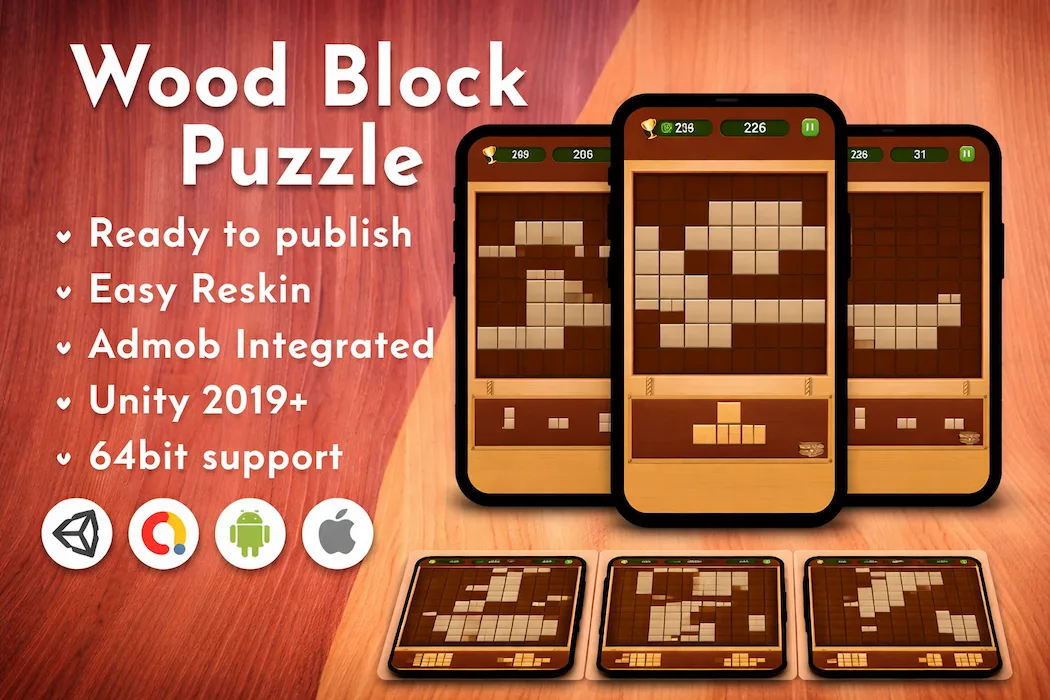

Some game concepts never go out of style, and the wood block grid puzzle is one of them. It's the kind of format players already understand before the tutorial even loads — drag a piece, fit it into the grid, clear a line, repeat. Simple to explain, surprisingly hard to put down. This Unity-built template packages that entire experience into a clean, ready-to-publish project, so developers can skip the groundwork and move straight into branding and launch.
Rather than fighting to invent a new mechanic, this project leans on a format with a long, proven track record across mobile app stores — and hands developers a working build instead of a blank scene.
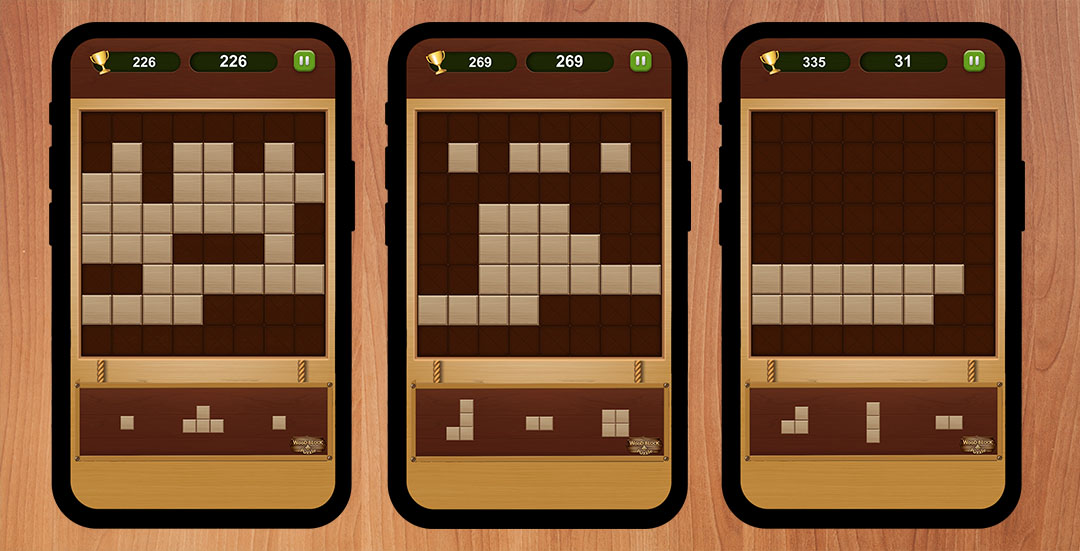
The rules stay intentionally minimal: place wooden block pieces onto a grid, aim to complete full rows or columns, and clear them before the board fills up. There's no timer forcing frantic decisions and no combat system to learn — just spatial reasoning, one placement at a time.
As the grid fills up, the same simple placement decisions start requiring real foresight. That natural difficulty curve — no added mechanics, just tighter space — is exactly what keeps block puzzle formats replayable across every age group, not just dedicated puzzle fans.
This isn't a stripped-down demo — it's a working game ready to reskin and ship.
Turning this template into your own release is a short process rather than a long development cycle:
Because the codebase separates visuals from core logic, most of that customization work touches art and UI rather than gameplay scripts.
If matching-and-sorting mechanics interest you more than a fixed grid, it's worth comparing this template against a genre-adjacent option like a 3D tile-matching game, which handles spatial puzzles through stacking and pairing rather than line clears — a useful reference point when deciding which puzzle sub-genre fits your audience best.
Puzzle formats like this also tend to perform well across a wide age range, which broadens the addressable audience compared to more niche or reflex-heavy genres.
Developers deciding between a calm puzzle release and something with faster pacing might want to look at a runner-style template, where speed and reflexes replace spatial planning as the core skill — a good gut-check for which player mindset you're actually building toward.
A published build doesn't need to stay static. Common post-launch additions include:
If you're weighing whether a full genre-matching project — like a complete tile-match Unity build — might be a better long-term investment than expanding a block puzzle, it's worth studying how that format structures its own progression and content updates before deciding.
Developers building a catalog around grid and matching mechanics often benefit from offering a few variations side by side. A second tile-runner style project, or a different runner Unity template, can appeal to players who want faster pacing without abandoning the puzzle-adjacent audience entirely. Similarly, a tile world match-3 Unity game gives a color-matching alternative that pairs naturally with a block-placement release like this one.
If you're still deciding what to develop next, browsing what's currently gaining traction on the Trending Items page can offer a quick read on which genres are seeing renewed interest. For a more structured decision process, the guide on best Unity source code projects for beginners in 2026 walks through genre tradeoffs in more depth, and the comparison of Unity source code versus building a game from scratch is worth reading if you're still weighing licensing a template against building one from zero.
The Wood Block Puzzle Unity Project delivers exactly what a developer needs to launch quickly: a proven, addictive mechanic, a clean codebase, and a structure built for reskinning rather than rebuilding. For anyone targeting a broad, casual mobile audience without wanting to design a puzzle system from scratch, this template offers a fast, low-risk path from download to published app.
Requirements: Unity free license version 2019 or later. macOS and Xcode required for iOS builds.
Current version: Unity 2019.4.22f1
Is this template beginner-friendly for someone new to Unity?
Yes. The project is structured clearly enough that developers learning Unity can study a working puzzle game while also using it as their first real publish.
Can I change the block shapes, colors, or overall theme?
Yes. The visual layer is fully separated from the core gameplay logic, so reskinning colors, block designs, and UI elements doesn't require touching the underlying mechanics.
Does this project support both Android and iOS?
Yes, it's built with cross-platform support in mind, though iOS builds require macOS and Xcode.
What Unity version should I use to open this project?
The current version is Unity 2019.4.22f1, and a free Unity license from 2019 or later is required.
Is monetization already included in this template?
The base package focuses on core gameplay mechanics; ad integration and monetization setup can be added separately depending on your chosen ad network.
How long does support and updates last after purchase?
The regular license includes 3 months of support, while the extended license extends that to 6 months alongside broader usage rights.
Is the wood block puzzle genre still worth building for in 2026?
Grid and line-clearing puzzle games remain consistently popular because the mechanic is instantly understandable and appeals across nearly every age group, making it a low-risk genre for both new and experienced developers.
You need to login to comment!
Total Sold:
0
Total Comments: