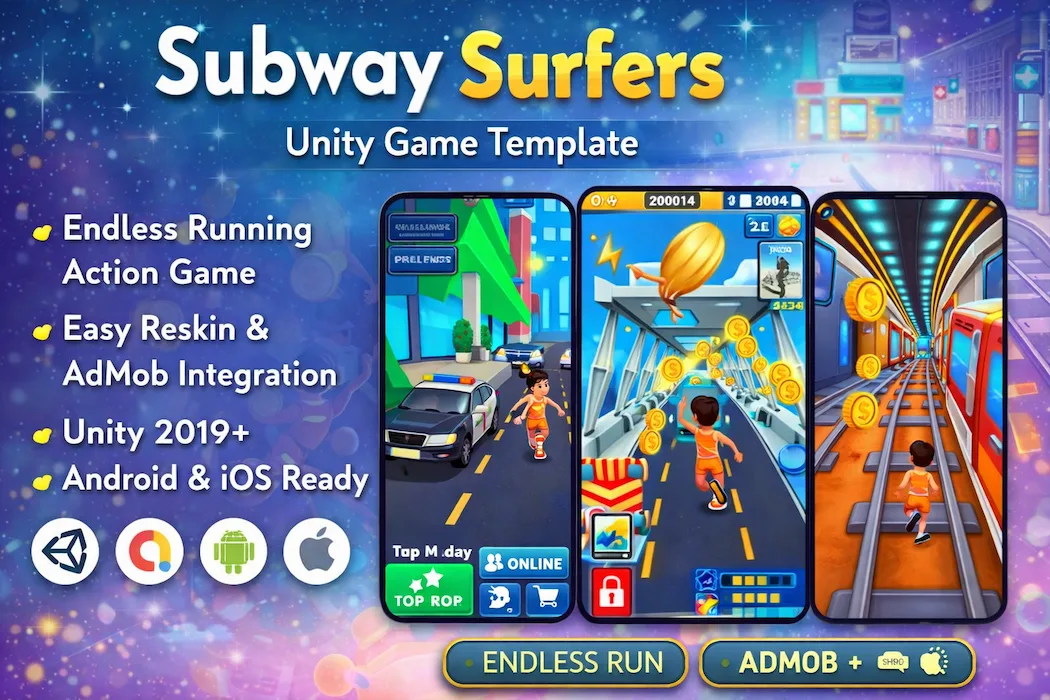

The Subway Runner Unity Game Source Code is a complete, production-ready endless runner mobile game template built in Unity 6000. It delivers everything a developer needs to publish a high-energy, fast-paced runner game on Android and iOS — fully functional gameplay, smooth swipe controls, coin collection, obstacle dodging, an increasing speed system, and a complete AdMob monetization infrastructure — all in a clean, well-organized Unity project you can customize and submit to Google Play within days of purchase.
Endless runner games are one of the most proven, evergreen categories in mobile gaming. This is not a trend — it is a category with over a decade of consistent top-chart performance driven by the simplest, most universally addictive core loop in mobile gaming: run, dodge, survive, beat your score, try again. The Subway Runner Unity template captures this formula precisely and delivers it in a developer-friendly package that is genuinely ready to publish.
Whether you are an indie developer launching your first mobile game, a small studio building a game portfolio, or a freelance developer fulfilling a client project, this Unity endless runner source code gives you a professional, optimized starting point that eliminates months of foundational development work.
Before diving into what this template includes, it's important to understand exactly why building an endless runner game is such a strong business decision in 2026.
Instant global appeal. The endless runner mechanic transcends language, age, and gaming experience. A five-year-old and a forty-year-old pick up and understand an endless runner in the same three seconds. This universal accessibility is the foundation of the genre's extraordinary download numbers — there is no audience segment that cannot play this game.
Zero learning curve eliminates tutorial drop-off. The leading cause of player loss in mobile games is the tutorial phase. Players who don't understand a game within the first minute uninstall. Endless runners have no meaningful tutorial. Players are running and dodging from the first second — which is why Day 1 retention in the endless runner genre is consistently among the highest of any mobile game category.
The high-score psychology creates infinite replays. Every run ends. The player sees their distance, score, and coin total. They have a new high score to beat, or they're furious they didn't beat the last one. This creates an immediate, emotional retry impulse that drives session after session after session. There is no story to finish, no campaign to complete — just one more run, always just one more run.
AdMob revenue structure fits perfectly. Each run ends with a natural screen break — the game-over screen. This is the most natural, non-intrusive ad placement in mobile gaming. Rewarded ads for revives, interstitials between runs, and coins-for-ads rewarded formats all slot into the gameplay loop without disrupting the experience. This means higher ad engagement rates and better player retention simultaneously.
Low device requirements maximize audience size. Endless runners are lightweight and performant on budget Android devices. Your game is playable by the full global Android user base — not just premium device owners. This is critical for markets like India, Southeast Asia, Latin America, and Africa, where mid-range and low-end Android devices dominate.
Viral shareability drives organic growth. Personal high scores, especially dramatic ones, get shared. A player who runs 8,000 meters for the first time screenshots it and sends it to five friends. This organic sharing loop, combined with the competitive pressure it creates, is free marketing that compounds over time.
If you want to understand how developers are using ready-made Unity source code to capitalize on these advantages in 2026, the blog post Why Ready-Made Unity Source Code Can Speed Up Game Development in 2026 covers the full strategic case with clarity and depth.
The Subway Runner Unity template delivers a complete, polished gameplay experience across every mechanical dimension of the endless runner genre.
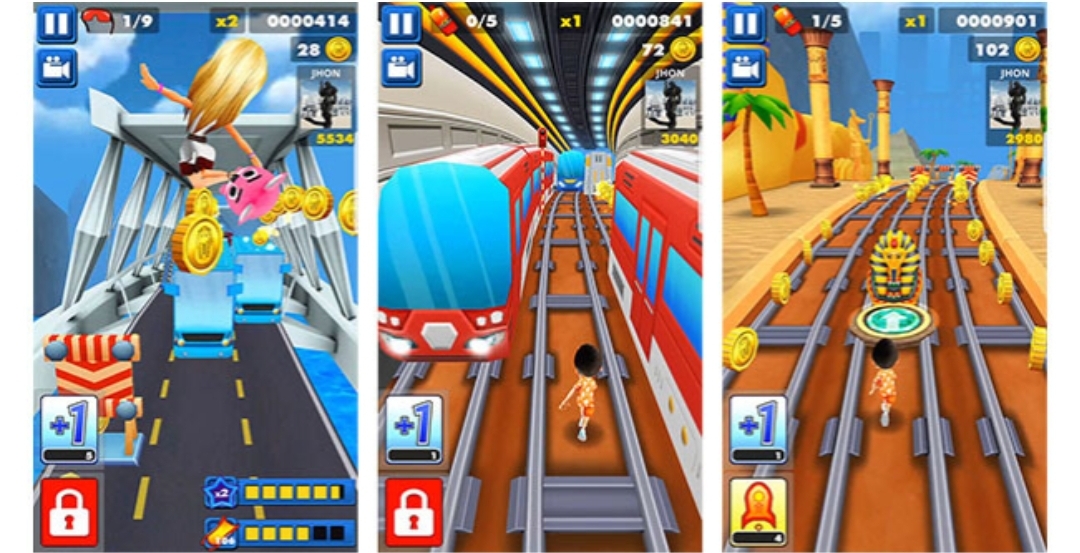
The game world is divided into three running lanes — left, center, and right. Players swipe left or right to switch lanes instantly, dodging obstacles and trains placed in specific lane patterns that force players to think and react simultaneously. The lane-switch animation is smooth and responsive, with no input lag — critical for a game where frame-perfect reactions determine survival.
Lane patterns are designed to be learnable but never fully predictable. Players develop real reflexes that improve run by run, creating the genuine skill growth that keeps engagement high over hundreds of sessions.
Players swipe up to jump over low obstacles and swipe down to slide under barriers that block the full lane. Both actions connect to character animations that are smooth, readable, and satisfying. The jump arc is tuned for mobile play — high enough to clear obstacles with margin, tight enough to feel precise and skill-based rather than floaty.
Combining jump, slide, and lane switches in rapid sequence creates the high-skill-expression moments that players love to screenshot, share, and brag about.
The obstacle system generates a continuously varied layout of barriers, trains, barricades, and hazards across all three lanes. Obstacle density and complexity scale with distance — the first few hundred meters are forgiving and let players find their rhythm, while the game becomes genuinely demanding at longer distances.
The procedural placement system ensures no two runs feel identical, which is the core mechanical secret behind endless runner replayability. Players are never memorizing a fixed level — they are always reacting to new situations.
The game world starts at a comfortable running pace and accelerates steadily as distance increases. Speed escalation creates natural difficulty progression without any level design overhead — the same obstacle layout becomes significantly harder at higher speeds, and the same player skill gets genuinely tested in new ways as the game pushes faster.
The speed curve is tuned to feel rewarding rather than punishing — players feel the satisfaction of surviving longer and moving faster, not the frustration of an artificially unfair difficulty spike.
Coins appear throughout the world in lines, arcs, and cluster patterns that sometimes require deliberate lane choices to collect. The coin system creates a secondary layer of decision-making during runs — do you take the safe lane or dodge into the coin line for maximum collection?
Accumulated coins drive the upgrade and unlock systems that power long-term player retention.
Four-directional swipe detection handles all player inputs: swipe right to move right, swipe left to move left, swipe up to jump, swipe down to slide. The swipe detection system uses threshold-based input reading that distinguishes intentional swipes from accidental touches — eliminating the false-input frustration that kills retention in poorly built runner games.
The control feel is tight, responsive, and calibrated for mobile screen sizes from compact 5-inch phones to large 6.7-inch displays.
The game tracks running distance in real time, displayed prominently in the gameplay HUD. Score is calculated from distance plus coin bonuses plus combo multipliers. Both current score and personal best are tracked persistently across sessions, creating the competitive high-score loop that drives replays.
The personal best system uses Unity's PlayerPrefs for local storage — no server-side backend required, meaning your game works offline and has zero server costs.
The player character has smooth, fully animated states for all actions: running, lane switching, jumping, sliding, landing, and collision. Animations are tuned for visual clarity at high game speeds — players can read their own state at a glance, which is essential for skill-based gameplay.
The animation system uses Unity's Animator with a clean state machine structure that is straightforward to extend if you want to add new character skins with unique animations.
The game world is generated procedurally using a tile-based segment spawning system. Track segments containing different obstacle configurations, coin patterns, and visual environments are spawned ahead of the player and recycled behind them. This object-pooling approach means the game world is infinite without any runtime memory allocation — critical for smooth, consistent performance on mobile.
Segment variety ensures visual freshness throughout long runs. Players are not looking at the same repeated tunnel for five minutes straight — the world changes and evolves around them.
The template includes a thoroughly implemented AdMob monetization system covering all three major ad formats:
Rewarded Ads — Revive System: When a player collides with an obstacle and the run ends, the game-over screen offers a "Continue?" prompt with a rewarded video ad. Watching the ad grants a one-time revive per run that lets the player keep their distance and score and continue from the crash point. This is the highest-converting ad format in endless runners because the emotional investment of a long run makes players willing to watch ads to save it.
Interstitial Ads — Between Runs: A configurable frequency system displays interstitial ads between runs — triggered after a set number of game-overs or a time interval from the last interstitial. The frequency setting is an Inspector-exposed variable, letting you tune the balance between revenue and player experience without code changes.
Rewarded Ads — Coin Doubler: A post-run "Watch an ad to double your coin reward" prompt is implemented on the score screen. This format converts well because players are already in a reflective moment reviewing their run and the coin reward feels like a meaningful bonus.
Banner Ads: Banner ad placement is available on the main menu and loading screens for passive impression-based revenue that complements the interactive ad formats.
All AdMob placements are clearly marked in the code with comments showing exactly where your ad unit IDs go. Test mode is toggled with a single boolean — no risk of accidentally serving live ads during development.
The template includes a power-up framework with two default power-ups: a coin magnet that pulls nearby coins automatically for a duration, and a shield that protects against one obstacle collision. Both are spawnable in the world during runs and have visual effect systems already implemented.
The power-up system is modular — adding new power-up types requires creating a new class that extends the base power-up interface. No existing systems need modification to add a speed boost, score multiplier, or any other power-up type.
The template includes a character selection screen accessible from the main menu, with a slot-based UI that supports multiple characters. Each character slot can be locked (requiring coins or a rewarded ad to unlock) or free. The selected character persists across sessions.
This system provides a direct long-term retention driver — players run to earn coins, coins unlock new characters, new characters give players a reason to keep running.
Every screen is implemented, designed, and functional:
A full audio system covers every audible moment in the game: running footstep sounds that speed up with game velocity, coin collection sounds, obstacle collision effects, power-up activation sounds, jump and slide audio cues, game-over stings, menu button sounds, and looping background music with fade logic between screens.
All audio is controlled through a central AudioManager singleton with global mute controls hooked to the settings menu.
The template is pre-optimized for the full range of Android device performance tiers:
The game runs at 60fps on current mid-range Android devices and 30fps minimum on low-end devices running Android 9.0 and above.
Every script follows Unity C# best practices with single-responsibility design:
Every file includes XML documentation comments on public methods. Any Unity developer with intermediate C# experience can navigate, understand, and extend this codebase immediately.
First-time mobile game publishers — The endless runner genre is the ideal first game because the mechanics are universally understood, the monetization is straightforward, and the production scope is manageable. This template removes all the infrastructure work and lets you focus on customization and launch.
Freelance developers on client projects — A client requesting a subway-style runner game can be delivered in a fraction of the time building from zero would require. The clean code and documentation make project handoffs straightforward.
Indie studios building game portfolios — The visual reskin architecture is built for producing multiple distinct-looking games from one strong codebase. Different character sets, environmental themes, and UI color palettes can produce entirely different-feeling products.
Developers diversifying their portfolio — If your background is in puzzle games, strategy games, or simulation titles, this template gives you an instant foothold in the highest-traffic category on the Play Store without a multi-month development investment.
Students learning Unity through real projects — The clean, modular code structure of this template is an excellent real-world case study in how a production mobile game is architected. You will learn more from reading this codebase for a week than from a month of isolated tutorials.
If you're building a game portfolio or looking for your next project after this one, here are six outstanding Unity game source codes available right now across a wide range of genres — each one production-quality, AdMob-integrated, and ready to publish:
A rhythm action shooter game where gameplay syncs to a neon-soaked EDM soundtrack. Players attack enemies in time with the beat, combining shooting mechanics with music rhythm gameplay in a visually stunning package. Beat EDM Weapon is one of the most unique genre combinations in the catalog — rhythm games generate enormous engagement from music-passionate audiences, and the action layer makes it immediately accessible. At just $29, this is exceptional value for a complete, unusual game concept with strong viral potential.
View Mountain Climb Stunt Car →
Drive and perform epic stunts on extreme mountain tracks in this 3D stunt car game. Players tackle steep inclines, massive jumps, and physics-challenging terrain that tests both vehicle control and track knowledge. The mountain climb stunt format is one of the highest-engagement casual game categories on mobile, driven by satisfying physics crashes, spectacular completion moments, and natural sharing appeal. This complete Unity 3D source code includes vehicle physics, stunt level design, coin collection, and AdMob integration — all at a price that makes it one of the best-value 3D game templates available.
View Real Sniper Legacy Shooter 3D →
A 3D sniper game with realistic combat action, scope mechanics, target prioritization, and mission-based level structure. The sniper game genre has a massive dedicated audience on mobile — players who want the precision and patience of real marksmanship translated into bite-sized mobile sessions. This template delivers all the core sniper mechanics: bullet drop, wind adjustment, scope zoom controls, enemy patrol AI, and mission briefing screens. At $249 for a complete 3D shooter with production-quality presentation, this is outstanding value for developers targeting the action game market.
A reskin-ready tower defense battle game where neighbors defend their territory against waves of monsters. Tower defense games combine strategic depth with satisfying visual feedback — players place defenses, watch waves arrive, upgrade towers, and feel the genuine satisfaction of a perfectly designed kill zone wiping out an enemy wave. This Unity template includes the full tower placement system, wave spawning logic, upgrade tree, and enemy AI — all for just $34, making it one of the most affordable complete tower defense source codes available.
An MP3 piano game with ready-to-publish presentation, easy reskin architecture, and full ad services integration. Piano Tiles-style games have a loyal, dedicated player base that generates consistently strong session lengths and ad revenue. This Unity template is reskin-ready with easy music track swapping, multiple game modes, and clean tile-tap mechanics. The $269 price reflects the genre's proven commercial value — piano tile games with quality music selections and smooth mechanics regularly achieve strong Play Store ratings and sustained downloads.
A fun and addictive 3D car survival game where players dodge traffic, collect power-ups, and survive as long as possible on an increasingly chaotic road. Cars Survive 3D brings the endless survival genre into three dimensions with a bright, colorful visual style and satisfying car physics. The 3D perspective gives it visual differentiation from standard 2D traffic racers while keeping the controls simple and accessible. At $74, this reskin-ready template is an excellent entry point into the 3D casual game market.
These six games are just a small selection of what's available. The complete Unity game source code library covers dozens of genres and game types — from multiplayer board games and FPS shooters to hyper-casual tap games, puzzle games, simulation titles, and much more.
👉 Browse All Unity Game Templates →
Whether you're looking for your first game, your next reskin project, or a deep technical reference for a new genre, the full catalog has options at every price point and complexity level.
Best for solo developers and freelancers building a single published game.
Best for studios, developers publishing multiple reskins, or anyone requiring extended commercial rights.
Publish to App Store — +$99: Full Google Play or App Store submission including store listing, screenshots, icon, and submission management.
App Store Optimization:
iOS Build Service — +$149: Full Xcode build configuration and iOS-compatible project delivery.
Custom Branding — +$99: Brand integration including logo, custom color scheme, and icon design.
Full Reskin Service — +$1,999: Complete visual transformation including new character art, environmental themes, UI redesign, custom audio, and new branding — delivered as a ready-to-publish project.
Extended Support — +$50: Additional 3 months of priority technical support.
GUI Kit: Included free with all purchases — a complete set of UI design assets usable across multiple projects.
| Detail | Specification |
|---|---|
| Engine | Unity 6000 or Higher |
| Unity Version (Dev) | 2021.2.7f1+ |
| Language | C# |
| Platforms | Android, iOS |
| Android Versions | 9.0, 10.0, 11.0, 12.0, 15.0 |
| iOS Build | macOS + Xcode required |
| Package Contents | APK, Documentation, PNG |
| Last Updated | 03 June 2026 |
| Initial Release | 31 October 2022 |
| Tags | AdMob, Adventure, Analytics, Endless Runner, Complete Game, Unity Engine |
Do I need iOS to build for Android?
No. Android builds are handled entirely within Unity on Windows or macOS. iOS builds require a Mac with Xcode — if you need iOS support without a Mac, the iOS Build Service add-on handles this for you.
How difficult is it to change the character and environment visuals?
Character and environment assets are organized in clearly labeled project folders. Swapping character meshes or sprites and replacing environment tile textures does not require modifying any gameplay code. A complete visual reskin can typically be completed in one to three days.
Can I add new power-ups beyond the two included?
Yes. The power-up system is modular and uses an interface pattern. Adding a new power-up type requires creating one new class that inherits the base interface — no existing files need modification.
Does the AdMob integration support Google's latest policies?
The template uses the Unity Google Mobile Ads SDK. Verify you are using the current SDK version at the time of your build, as Google updates its SDK periodically. Instructions for updating the SDK are in the documentation.
Is the procedural generation truly infinite or does it eventually repeat?
The segment pool contains enough variety that repetition is not perceptible during normal play sessions. For longer development cycles, adding new segment types to the pool is straightforward and documented.
Can I use this template for multiple published games?
The Regular License covers one published application. For multiple published reskins from this codebase, the Extended License is required.
What kind of technical support is included?
The support team assists with Unity project setup, AdMob configuration, Android build issues, and customization guidance. Regular license holders receive 3 months of support. Extended license holders receive 6 months.
WhatsApp: +91 98835 09963 Microsoft Teams: Unity Source Code Team
Our support team is available to help with project setup, AdMob integration, build configuration, and customization questions. Response times are fast — most queries receive a reply within a few hours during business hours.
The Subway Runner Unity Game Source Code gives you a complete, production-quality endless runner game that is ready to customize and publish. The procedural world generation, responsive swipe controls, complete AdMob monetization infrastructure, and clean modular codebase put you months ahead of building from scratch.
The endless runner format is proven, the audience is global, and the AdMob revenue structure is one of the cleanest in mobile gaming. Your task is to make it yours — new visual theme, new characters, new name — and get it on the Play Store.
At $189 for the Regular License, this is one of the most cost-effective entry points into one of mobile gaming's most enduringly popular genres.
Add to Cart — Regular License $189 Add to Cart — Extended License $399
You need to login to comment!
Total Sold:
0
Total Comments: